
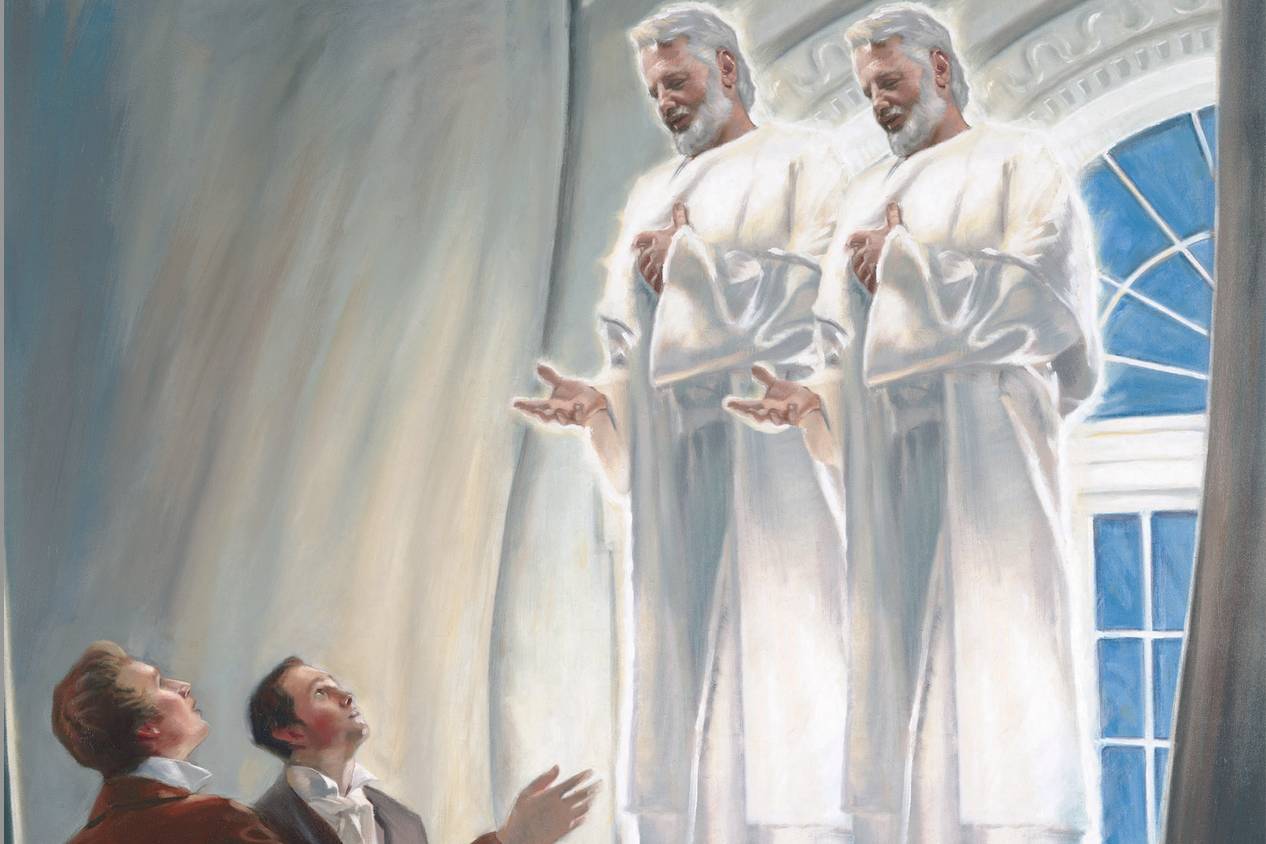
Behold, I will send you Elijah the prophet before the coming of the great and dreadful day of the Lord: And he shall turn the heart of the fathers to the children, and the heart of the children to their fathers, lest I come and smite the earth with a curse.
Malachi 4:5-6
Growing up in the LDS church I was taught, and fully believed, that Joseph Smith fulfilled many biblical prophecies and was visited by many biblical figures including the prophet Elijah mentioned in Malachi chapter 4. It wasn’t until I read the Bible for myself that I realized some inconsistencies in Joseph’s narrative about this prophecy that ultimately led me to realize his false teachings and false gospel.
This prophecy from Malachi chapter 4 is deeply significant to LDS history and theology. Since the early years of LDS church history, Joseph Smith claimed that the angel Moroni told him that the prophecy in Malachi chapter 4 had not been fulfilled yet and would be (and was) fulfilled through him. Joseph referred to this prophecy time and time again relating it to not only the restoration but also the priesthood and baptism for the dead. Joseph first mentions this prophecy about Elijah in his 1835 and 1838 church history accounts.
“When I was about 17 years old I saw another vision… an angel appeared before me… he explained many of the prophesies to me, one I will mention which is in Malachi 4.” (1835 Church History Account)
“He called me by name and said unto me that he was a messenger sent from the presence of God to me… he commenced quoting the prophecies of the Old Testament, he first quoted part of the third chapter of Malachi and he quoted also the fourth or last chapter of the same prophecy though with a little variation from the way it reads in our Bibles… he quoted the fifth verse thus, ‘Behold I will reveal unto you the Priesthood by the hand of Elijah the prophet before the coming of the great and dreadful day of the Lord.’ He also quoted the next verse differently, ‘And he shall plant in the hearts of the children the promises made to the fathers, and the hearts of the children shall turn to their fathers, if it were not so the whole earth would be utterly wasted at his coming.’” (1838 History of the Church)
So to begin, there’s a problem with Joseph’s story here. According to him, an angel of the Lord appeared and told him that Malachi’s prophecy about Elijah had not been fulfilled yet, when it absolutely had been fulfilled.
The Elijah Prophecy Already Fulfilled
Malachi chapter 4 lists three things that Elijah will do when he returns: prepare the way before Jesus, restore all things, and turn the hearts of the children and the fathers. Joseph Smith claimed that these prophecies had not been fulfilled until God restored the gospel and priesthood through him via heavenly visitations in the early 1800s. However, by reading the first couple books of the New Testament we can see that Joseph’s claim was utterly false. In three distinct places in the New Testament Jesus himself and the angel Gabriel state multiple times that all these prophecies about Elijah were fulfilled through John the Baptist. Here’s a breakdown of what Malachi prophesied Elijah would do and how Jesus and Gabriel said John the Baptist did those things.
Prepare & Restore
Prophecy:
Behold, I will send my messenger, and he shall prepare the way before me… (Malachi 3:1)
Fulfillment:
For this is he, of whom it is written, behold, I send my messenger before thy face, which shall prepare thy way before thee… For all the prophets and the law prophesied until John. And if ye will receive it, this is Elias, which was for to come. (Matthew 11:10-14)
And Jesus answered and said unto them, Elias truly shall first come, and restore all things. But I say unto you, that Elias is come already, and they knew him not, but have done unto him whatsoever they listed. Likewise shall also the Son of man suffer of them. Then the disciples understood that he spake unto them of John the Baptist. (Matthew 17:11-13)
Turn the Hearts
Prophecy:
Behold, I will send you Elijah the prophet before the coming of the great and dreadful day of the Lord: And he shall turn the heart of the fathers to the children, and the heart of the children to their fathers, lest I come and smite the earth with a curse. (Malachi 4:5-6)
Fulfillment:
But the angel said unto him, Fear not, Zacharias: for thy prayer is heard; and thy wife Elisabeth shall bear thee a son, and thou shalt call his name John… And he shall go before him in the spirit and power of Elias, to turn the hearts of the fathers to the children, and the disobedient to the wisdom of the just; to make ready a people prepared for the Lord. (Luke 1:13-17)
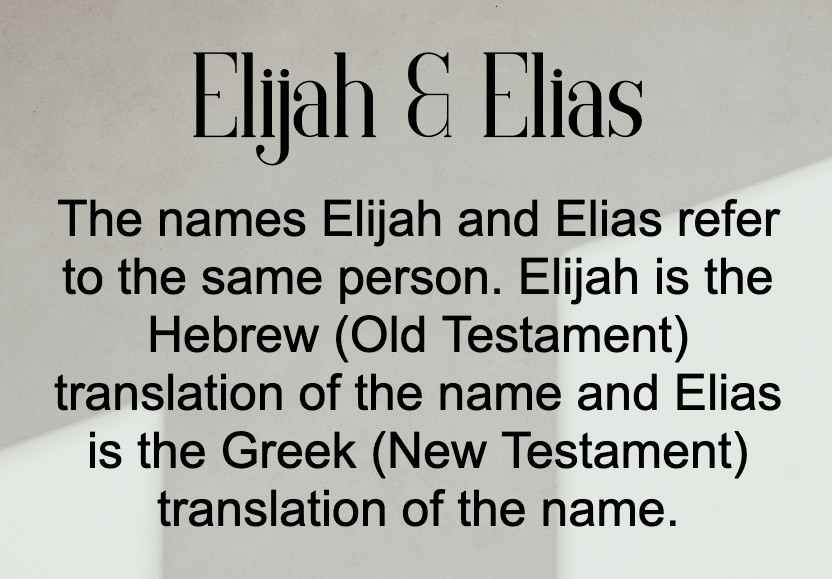
You may have noticed that there is a slight variation in the names in the verses above, Malachi says Elijah but Matthew and Luke say Elias. This is because Elijah is the Hebrew name in the Old Testament and Elias is the Greek translation of Elijah in the New Testament. It’s like translating the English name John into Spanish as Juan.
When I have shown the biblical references of John the Baptist fulfilling the Elijah prophecy I often get some comments asking about John 1:21, where John is questioned by the priests asking him if he is Elijah.
And they asked him, “What then? Are you Elias?” He said, “I am not.” “Are you the Prophet?” And he answered, “No.”
I think John’s response is completely reasonable for a few reasons. First of all, John was as human as the rest of us, we often doubt or misunderstand God’s spiritual calling on our lives. Though John knew he was “a voice crying in the wilderness” perhaps he didn’t think highly enough of himself to be called the Elias preparing the way before Christ. It’s evident that this title was not talked about much among the early church, because on the mount of configuration Jesus’s own disciples questioned when Elias would come. Jesus told them that Elias had come already and it was John, then they understood. Secondly, most would agree that John was not the actual reincarnated prophet Elijah, another reason for his denial to the priests. Even if one wants to argue that John was Elijah reincarnated, it’s simple enough to understand that John would not have remembered his past life identity.
Some argue the position of “dual fulfillment,” saying John was the Elias before Christ’s first coming and he will return again before his second coming. While I acknowledge history does repeat itself and we learn from generational patters, I don’t see any valid basis for dual fulfilment here. If John the Baptist fulfilled the prophecy by preparing people before and during Jesus’s ministry, then a second fulfillment would occur in a similar manner–a bold messenger calling people to repentance right before and during Jesus’s return. Of course some will say “Joseph was a bold messenger crying repentance,” but that’s not the claim. The claim is not that Joseph Smith was the “Elias” calling repentance, rather Joseph claimed that Elijah fulfilled the prophecy by simply appearing to him and giving him the special power of “priesthood authority.” I’ll write a dedicated article on the false doctrines of the priesthood soon, but for now you can check out the related videos at the end of this article.
Joseph Confuses Elijah and Elias
In the early accounts mentioned above, Joseph does correctly correlate Malachi’s prophecy about Elijah with John the Baptist (claiming John fulfilled the prophecy by restoring the priesthood), but it’s clear Joseph must not have realized that Elijah and Elias are the same name in two different languages because in other revelations he referred to Elijah and Elias as two distinct individuals with unique roles. After a decade of speaking about the separate identities of Elijah and Elias, Joseph changes his stance around 1840 and refers to them as one in the same. Here are the events we will look at to analyze Joseph’s theology on this subject over the years.
Timeline:
- 1831 Joseph’s inspired Bible translation changes the words in John chapter 1 to say that Jesus is Elias
- 1833 original D&C 27 revelation published without mention of any heavenly messengers
- 1835 D&C 27 republished including additional verses about Elijah and Elias as two individuals
- 1836 D&C 110 Kirtland temple revelation mentioning Elijah and Elias separately, Elijah says “the time has fully come which was spoken by Malachi”
- 1836-1839 Joseph studies Hebrew and Greek
- 1840 Baptism for the dead is taught and practiced for the first time
- 1840 Joseph writes in the Times and Seasons that Elijah and Elias are the same, never mentions Elias again
- 1842 Joseph retroactively attaches baptism for the dead to Elijah’s mission and fulfilment of Malachi’s prophecy, six years after “fully” fulfilling Malachi’s prophecy in Kirtland
- 1843 Joseph tries to justify how John the Baptist was and was not the Elias
– D&C 27 –
The first place I noticed Joseph confusing the translation of one name in two languages for two separate individuals was in D&C 27, however not in it’s original form. This section in dubious for more than one reason. When it was originally published in the 1833 Book of Commandments it was 7 verses long, totaling 193 words. However when Joseph republished this same revelation in the 1835 Doctrine and Covenants it suddenly contained 18 verses totaling 649 words. What had been a short instruction on the use of water or wine for the ordinance of the sacrament had turned into a very long revelation describing a joyous reunion of Jesus and a dozen biblical prophets and heavenly messengers all drinking wine in communion with Joseph. Among these listed were both Elias and Elijah, mentioned as two separate people with distinct roles. Though Joseph claimed to have had this revelation in 1830, these details were never mentioned or published until 1835. Here are a few of the added verses in the 1835 D&C 27 compared to the original.
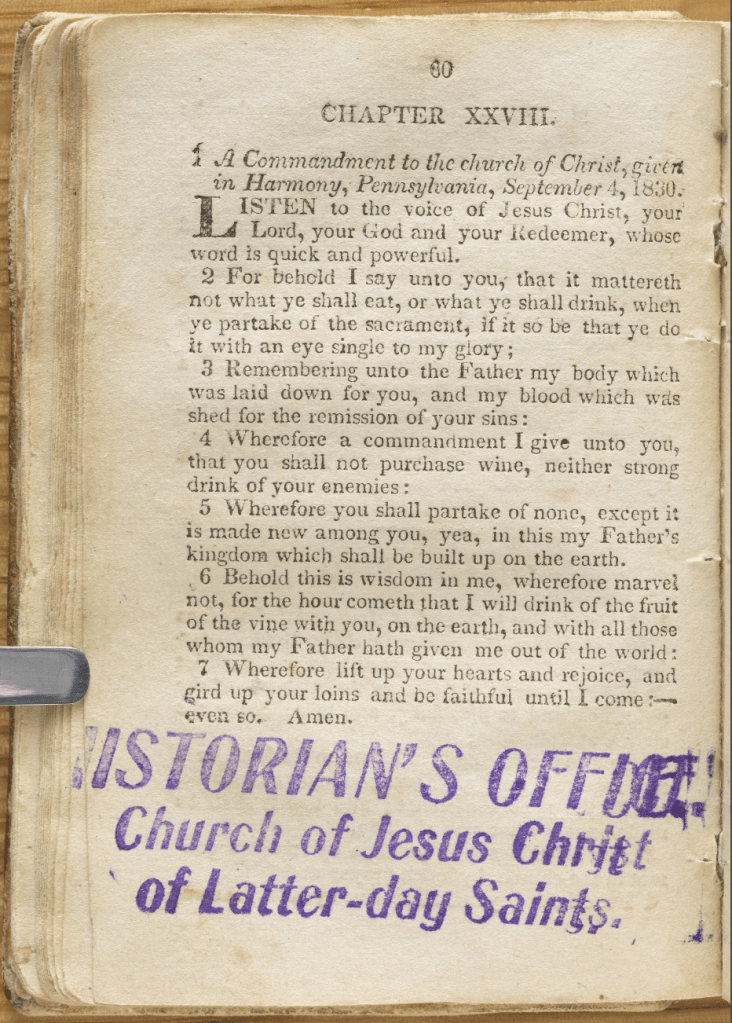
5 Behold, this is wisdom in me; wherefore, marvel not, for the hour cometh that I will drink of the fruit of the vine with you on the earth, and with Moroni, whom I have sent unto you to reveal the Book of Mormon, containing the fulness of my everlasting gospel, to whom I have committed the keys of the record of the stick of Ephraim;
6 And also with Elias, to whom I have committed the keys of bringing to pass the restoration of all things spoken by the mouth of all the holy prophets since the world began, concerning the last days;
7 And also John the son of Zacharias, which Zacharias he (Elias) visited and gave promise that he should have a son, and his name should be John, and he should be filled with the spirit of Elias;
8 Which John I have sent unto you, my servants, Joseph Smith, Jun., and Oliver Cowdery, to ordain you unto the first priesthood which you have received, that you might be called and ordained even as Aaron;
9 And also Elijah, unto whom I have committed the keys of the power of turning the hearts of the fathers to the children, and the hearts of the children to the fathers, that the whole earth may not be smitten with a curse.
From these verses we can see that Joseph Smith described Elias and Elijah as two individuals with different roles. Verse 9 says that the role of Elijah was to commit the keys of power (the priesthood) to turn the hearts of the children and the fathers, which Joseph alleges happened in 1829 when John the Baptist gave him and Oliver Cowdery the priesthood. But verse 6 says that the role of Elias was to commit the keys of restoring all things. Verse 7 is also interesting, where Joseph claims Elias was the angel who told Zacharias his wife Elizabeth would have a son in her old age– but that was not Elias, that was the angel Gabriel according to Luke chapter 1. Yes Elias means “messenger,” but it was not the name of the angel.
Some argue the position of “dual fulfillment,” and while I acknowledge history does repeat itself and we learn from generational patters, I don’t see any valid basis for dual fulfilment here. If John the Baptist fulfilled the prophecy by preparing people before and during Jesus’s ministry, then a second fulfillment would occur in a similar manner–a bold messenger calling people to repentance right before and during Jesus’s return. Of course some will say “Joseph was the bold messenger crying repentance,” but that’s not the claim. The claim is not that Joseph Smith was the “Elias” calling repentance, rather Joseph claimed that Elijah fulfilled the prophecy by simply appearing to him and giving him the special power of “priesthood authority.” There is much more to discuss about the false doctrines of the priesthood, I’ll write a dedicated article on that subject soon, but for now you can check out the related videos below.
– JS Translation of the Bible –
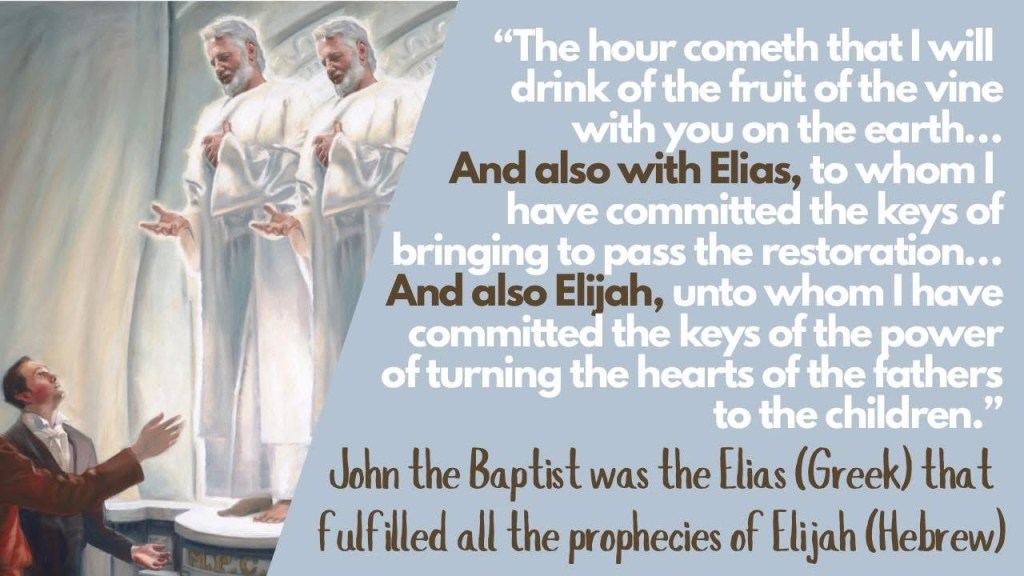
In the very early days of the church Joseph not only didn’t realize that Elias and Elijah were one in the same, but in his 1831 translation of the Bible he altered the verses we read above about John being questioned by the priests about who he was. In Joseph’s version, John not only denies being Elias, but also claims that Jesus himself was Elias. This is found in John chapter 1 of the Joseph Smith Inspired Version of the Bible. Here is the original manuscript of these Bible revisions.
27 John answered them, saying, I baptize with water, but there standeth one among you whom ye know not;
28 He it is of whom I bear record. He is that prophet, even Elias, who, coming after me, is preferred before me, whose shoe’s latchet I am not worthy to unloose or whose place I am not able to fill; for he shall baptize, not only with water, but with fire and with the Holy Ghost.
– D&C 110 –
One year after adding the additional verses about Elijah and Elias to D&C 27, Joseph mentions being visited by Elias for the first time. In April of 1836 Joseph had another revelation we now know as D&C 110 where he describes being visited in the Kirtland temple by several more heavenly messengers including Elias, and again Elijah, separately. Just days before this visit from Elias, Joseph Smith and many of his cohorts had gathered in the Kirtland temple for a full day of fasting and prayer. They described a “day of pentecost” and an out pouring of angels and spiritual gifts. A few days after this day of fasting at the Kirtland Temple, Joseph and Oliver record another vision in the temple and being visited by several biblical prophets yet again.
12 After this, Elias appeared, and committed the dispensation of the gospel of Abraham, saying that in us and our seed all generations after us should be blessed.
13 After this vision had closed, another great and glorious vision burst upon us; for Elijah the prophet, who was taken to heaven without tasting death, stood before us, and said:
14 Behold, the time has fully come, which was spoken of by the mouth of Malachi—testifying that he [Elijah] should be sent, before the great and dreadful day of the Lord come—
15 To turn the hearts of the fathers to the children, and the children to the fathers, lest the whole earth be smitten with a curse.
16 Therefore, the keys of this dispensation are committed into your hands; and by this ye may know that the great and dreadful day of the Lord is near, even at the doors.
So now we have three instances of Joseph mistakenly creating two identities from one Biblical character. (He also does this in D&C 76:100 where he describes Isaiah and Esaias as two individuals, when they are also the same name translated from Hebrew to Greek). According to D&C 27 and D&C 110, Joseph thought that the role of Elijah was to commit the keys of power (priesthood) and turn the hearts of the children and fathers. And on the other hand, the role of Elias was to restore all things and open the “dispensation of the gospel of Abraham.” This is very peculiar, the “gospel of Abraham” is not a biblical term nor prophecy. Christians are to follow the gospel of Jesus Christ, the new covenant he established, so why would we revert back to the Old Testament gospel of Abraham? It seems this is another inaccurate conflation caused by Joseph throwing various biblical terms together in his preaching without sound understanding of the gospel of Jesus Christ.
I’m aware that some individuals are suspicious of section 110, wary of it’s authenticity as it was not added to the Doctrine & Covenants until 1876. However after much investigation into these suspicions, I’ve come to agree with the historian and document expert John Hajicek, that the revelation is authentic and there is no reason to doubt it’s authenticity. (I don’t have a link to an article for this reference, but a Google search will pull up Facebook comments made by John Hajicek on the discussion of the authenticity of D&C 110). The earliest version of the revelation we have today is in the handwriting of Warren A Cowdery, an official scribe to Joseph Smith until he left the church in 1838 (long before any Brighamite forgeries or alterations). The contents of D&C 110 are also corroborated by Joseph’s journal entry from the same day, April 3, 1836, describing similar details of the revelation. Since Joseph did not publish any later edition of the Doctrine & Covenants after 1835 we can’t imply that he deliberately chose to exclude D&C 110, it was just one of many revelations after 1835 that were never canonized.
– Joseph Studies Hebrew & Greek –
In late 1835 Joseph had a desire to learn more about the Biblical text and endeavored to learn Hebrew and Greek. Oliver Cowdery supplied Hebrew and Greek lexicons and a group gathered frequently to study. In the spring of 1836 a certified Hebrew teacher was hired and the group began a 7 week Hebrew class. By the end of it Joseph received a certificate stating he had acquired the principles of reading and translating from the Hebrew Old Testament. But keep in mind this was still a very introductory course to Hebrew and he was by no means fluent (anyone who learned a language in the MTC can attest to that). Just four days after receiving his Hebrew certificate Joseph recorded the April 1836 revelation (D&C 110) where he still referred to Elijah and Elias as two individuals. He continued his study though, as we can see his 1836 journal is full of entries about studying Hebrew and sometimes Greek. Although Joseph didn’t organize formal classes to learn Greek, he still owned the Greek lexicon and some church members witnessed him studying Greek in 1838. According to this BYU religious study on Joseph Smith’s awareness of the Greek language, he didn’t start “regularly comment[ing] on the meaning of individual Greek words, especially in his Sunday sermons” until the fall of 1842.
At some point during his Hebrew and Greek studies Joseph must have encountered the true translation of Elijah to Elias. From 1835 to 1839 Joseph frequently mentioned both Elijah and Elias separately, but for the first time in 1840 he acknowledges they are the same. This 1840 Times and Seasons article (page 212) is the first time we see Joseph mention Elias and correctly identify him with Elijah. In this paragraph Joseph is referring to James 5:17, he had quoted this passage before, taking note of it in an 1835 journal entry. However in the 1835 quotation Joseph did not annotate the two names as one as he did here.
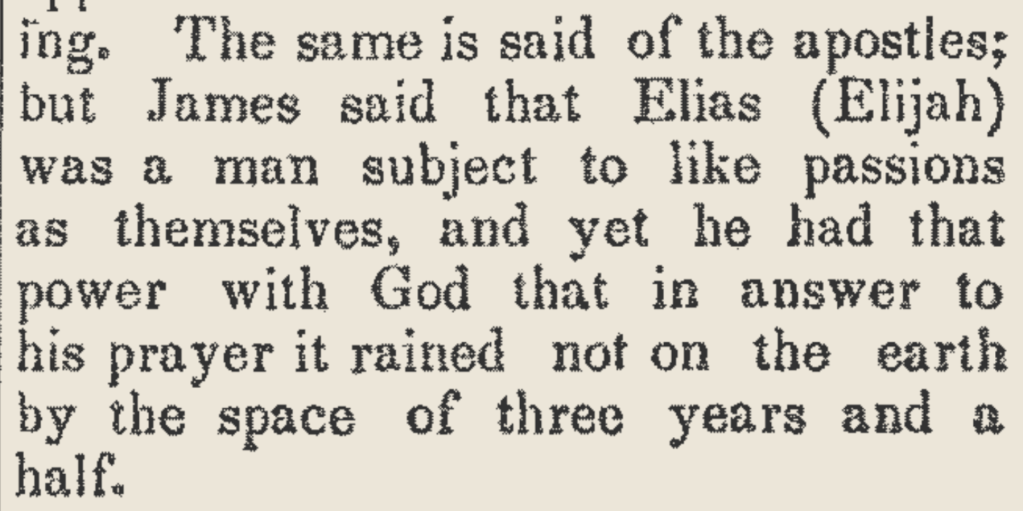
“The same is said of the apostles; but James said that Elias (Elijah) was a man subject to like passions as themselves, and yet he had that power with God that in answer to his prayer it rained not on the earth by the space of three years and a half.”
After 1840 Joseph never mentions Elias independently again and he shifts his focus solely to Elijah. Though some older revelations were republished with the original distinctions, new publications described them as the same. This created some issues with his past revelations which required Joseph to try to justify how both his past and current teachings could be true. In an 1843 Times and Seasons article (pages 120-122) Joseph explains how he believes John the Baptist both was and was not the Elias.
“John the Baptist came in his day an Elias a restorer. The angel Gabriel said that he came in the “spirit and power of Elias,” and if the people would have submitted to his teaching and to the teaching of our Savior, the things that are spoken of in the prophets would have been fulfilled; hence says our Savior, ‘if ye will receive it,’ this is the Elias which was to come; but he goes on to tell them that they would not receive it. He says ‘he that has ears to hear let him hear, but whereunto shall I liken this generation?’… Thus they rejected John the Baptist, and although he was indeed the Elias, he could not be so to them, and hence, when they asked him ‘art t·hou Elias?’ he said ‘I am not.’ They had forfeited the favor of Jehovah, the kingdom of heaven was taken from them, and the blessings of God withdrawn from their midst.”
Here Joseph claims that the people rejected John the Baptist therefore the things spoken by the prophets were not fulfilled. However Jesus testified that John was the Elias, Jesus did complete his mission and the prophecies were fulfilled. Yes Jesus (and John) were “despised and rejected by men” (Isaiah 53:3), that was part of the prophecy. Joseph’s claim that John failed as the Elias and the prophecy needed to be fulfilled again is completely false.
– D&C 128 –
In 1842 Joseph revealed new doctrine he claimed was very pertinent to Malachi’s prophecy and the role of Elijah (never mentioning Elias). While in hiding evading arrest Joseph wrote a letter to the church boldly claiming that Malachi had prophesied of Elijah not only restoring the priesthood, but also baptism for the dead. This new revelation now known as D&C 128 came two years after the practice of baptism of the dead began.
17 And again, in connection with this quotation I will give you a quotation from one of the prophets, who had his eye fixed on the restoration of the priesthood, the glories to be revealed in the last days, and in an especial manner this most glorious of all subjects belonging to the everlasting gospel, namely, the baptism for the dead; for Malachi says, last chapter, verses 5th and 6th: Behold, I will send you Elijah the prophet before the coming of the great and dreadful day of the Lord: And he shall turn the heart of the fathers to the children, and the heart of the children to their fathers, lest I come and smite the earth with a curse.
18 I might have rendered a plainer translation to this, but it is sufficiently plain to suit my purpose as it stands. It is sufficient to know, in this case, that the earth will be smitten with a curse unless there is a welding link of some kind or other between the fathers and the children, upon some subject or other—and behold what is that subject? It is the baptism for the dead…
This new information is very interesting, and if we compare it to his previous revelations about Elijah things don’t add up. In the 1836 temple vision Elijah had allegedly told Joseph “the time has fully come, which was spoken of by the mouth of Malachi” (D&C 110:14). Keep in mind that fully means complete. But now, six years after “fully” fulfilling Malachi’s prophecy, and two years after teaching and practicing baptism for the dead, Joseph reveals this new information, retroactively claiming that Malachi had actually prophesied of Elijah coming to restore baptism for the dead. How can this be? If Elijah had visited Joseph in 1830 and 1836, why didn’t he reveal or restore the saving ordinance of baptism for the dead at that time? It seems like that would be a pretty important thing to include if 1836 was the time to completely fulfill Malachi’s prophecy. Or when Joseph began teaching baptism for the dead in 1840, why didn’t he relate it to Malachi’s prophecy of Elijah turning the hearts and uniting families then?
– Conclusion –
I find it very interesting that up until 1836 Joseph was repeatedly claiming to be visited by angels and ancient prophets, but in subsequent years visitations are scarce to none. Even when the pinnacle doctrine of baptism for the dead was introduced in 1840 there was no mention of any angelic visitation or revelation. And for the first two years of teaching and practicing baptism for the dead there was no mention of a prophetic fulfillment or Elijah’s “welding link.” Yet again, in his retroactive addition of prophecy and scripture, Joseph ended up contradicting his past revelations.
Joseph’s evolution of understanding is evident after years of studying Hebrew and Greek. Though he initially naively claimed he was visited by both Elijah and Elias, he later acknowledges they are one in the same and never mentions Elias again. It would be disingenuous for someone to quote Joseph’s 1840’s statements about Elijah and Elias being the same and claim it was his consistent teaching from the beginning.
I’ll end with one more quote by Joseph Smith, ironically boasting of his intelligence and understanding of the ancient languages.
I have now preached a little Latin, a little Hebrew, Greek, and German; and I have fulfilled all. I am not so big a fool as many have taken me to be.
King Follett Discourse, 1844
 Ex-Mormon Bible Study
Leave a comment