
Salvation for the dead in LDS theology is one of the church’s most unique doctrines, and one of the most inconsistent. Not only does it push the limits of Biblical teachings, but the collective LDS canonized scripture on salvation for the dead and baptisms for the dead is laced with internal contradictions. In chronological order, these are the main teachings from Joseph Smith I’ll be examining in this article, red indicates internal contradictions. (You can click on a segment to jump to that portion of the article.)
1830, Moroni 8:22-23 “All little children are alive in Christ, and also all they that are without the law. The power of redemption cometh on all them that have no law wherefore he is not condemned, he that is under no condemnation cannot repent and unto such baptism availeth nothing.“
1832, D&C 76:72-77 “These are they who receive the Terrestrial world: they who died without the law, and also the spirits of men in prison whom the son visited who received not the testimony of Jesus in the flesh but afterwards received it. They shall receive the presence of the Son but not the fulness of the Father.“
1836, D&C 137:7-8 “All who have died without a knowledge of this gospel who would have received it if they had been permitted to tarry shall be heirs of the Celestial Kingdom.“
1840, Joseph Smith Letter to the Elders “The saints have the privilege of being baptized for those of their relatives who are dead, who they feel to believe would have embraced the gospel if they had been privileged with hearing it.“
1841, D&C 124: 29-33 “A baptismal font there is not upon the earth that my saints may be baptized for those who are dead. I command you to build a house unto me, and I grant unto you a sufficient time to build a house unto me; and during this time your baptisms shall be acceptable unto me. But behold, if you do not these things at the end of the appointment ye shall be rejected as a church with your dead.“
1842, D&C 128:14-18 “The earth will be smitten with a curse unless there is a welding link between the fathers and the children. And what is that subject? It is baptism for the dead.“
1844, King Follett Discourse “The greatest responsibility in this world that God has laid upon us is to seek after our dead… every man who has a friend in the eternal world can save him, unless he has committed the unpardonable sin. And so you can see how far you can be a savior.”
Just at a glance you can see the ever changing nature of this flip-flop philosophy. The biggest internal contradictions are regarding those who died without the law and also those who would have accepted the gospel on earth if they had the chance. Then towards the end of the article we will examine Joseph’s teachings on us being a savior for others. But before going any further I want to start with what the Bible says about those who die without the law and how God judges them.
God’s Judgement
In accordance with God’s perfectly loving nature, His judgement is perfectly just and perfectly gracious. I believe if we simply lean on the Bible’s clear teaching on this subject then any discussion about baptizing the dead would be completely futile. This question is clearly explained in Romans chapter 2.
12 For as many as have sinned without law will also perish without law, and as many as have sinned in the law will be judged by the law.
13 (For not the hearers of the law are just in the sight of God, but the doers of the law will be justified;
14 For when Gentiles, who do not have the law, by nature do the things in the law, these, although not having the law, are a law to themselves,
15 Who show the work of the law written in their hearts, their conscience also bearing witness, and between themselves their thoughts accusing or else excusing them).
This chapter plainly explains how God’s good reason and grace judges the lives of people who never knew him or heard his gospel. Since God is love (and his gospel is to love him and love others, Matthew 22:34-40), those who do not know him cannot love him, but they still can love others. This passage states that some people who don’t even know God’s law live it better than people who do. By living a life full of love, being honest, kind, generous and forgiving to our fellow man, many people fulfill Jesus’s commandments even without knowing who he is. This includes people all around the world who have never heard about Jesus. But thank God He is gracious and fair and he judges people by their hearts and their works. God judges us based on the fruit of our lives, not what information we had access to.
God’s Just and Gracious Judgement
- For the Son of Man will come in the glory of His Father with His angels, and then He will reward each according to his works. (Matthew 16:27)
- For we must all appear before the judgment seat of Christ, that each one may receive his due for the things done in the body, whether good or bad. (2 Corinthians 5:10)
- The righteous judgment of God, who will render to each one according to his deeds. (Romans 2:5-6)
- I the Lord search the heart, I test the mind, even to give every man according to his ways, according to the fruit of his doings. (Jeremiah 17:10)
Continuing on with Joseph’s doctrine, in my investigation into his teachings I also investigated the historical context surrounding each revelation. In this article I will analyze not only the doctrinal claims but also related historical background so we can understand the development of each layer of the doctrine of salvation for the dead. I will start with Joseph’s first publication, the Book of Mormon, then follow up with some religious background and life experiences of the Smith family that set the stage for the interest in salvation for the dead. Then we’ll examine the evolution of the doctrine of the dead within the Doctrine and Covenants while paying attention to important historical context surrounding each revelation.
1830, The Book of Mormon
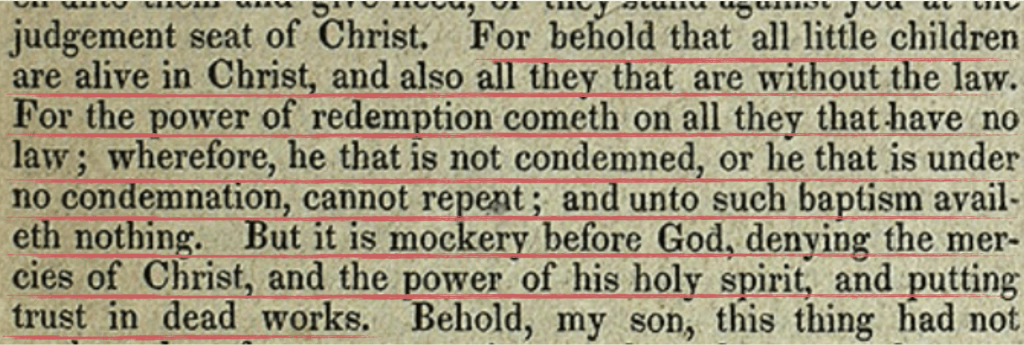
The Book of Mormon included the initial doctrine on the salvation of the unbaptized dead. Moroni 8:22-25 says that all children and those who die without the law are under no condemnation, therefore they cannot repent and baptism is unnecessary. Even stating that to baptize them mocks God, denies Christ’s mercy and puts trust in dead works. The Book of Mormon also taught that the dead cannot repent (Alma 34:34-35), and repentance is a prerequisite to baptism.
22 For behold that all little children are alive in Christ, and also all they that are without the law. For the power of redemption cometh on all them that have no law; wherefore, he that is not condemned, or he that is under no condemnation, cannot repent; and unto such baptism availeth nothing—
23 But it is mockery before God, denying the mercies of Christ, and the power of his Holy Spirit, and putting trust in dead works.
24 Behold, my son, this thing ought not to be; for repentance is unto them that are under condemnation and under the curse of a broken law.
25 And the first fruits of repentance is baptism; and baptism cometh by faith unto the fulfilling the commandments; and the fulfilling the commandments bringeth remission of sins;
Joseph’s Family Back Ground
Many associate the views on death found in the Book of Mormon to Joseph’s personal tragedy losing his older brother Alvin. However Alvin’s death was not the first time the Smith family had been vexed with the uncertainty of lost unbaptized souls. This topic was at the center of many family disagreements long before Alvin and Joseph were even born. I think it’s prudent to give a short overview of the religious divide in the Smith family to shine some light on the home environment and the debates Joseph Smith Jr was privy to growing up.
Joseph’s parents Joseph Smith Sr and Lucy Mack experienced loss very early on in their marriage. In 1797 their first son, either born premature or stillborn, did not survive. This loss quickly revealed that Joseph Sr and Lucy held very different views on the salvation of unbaptized souls. Lucy Mack had grown up devoutly orthodox, and although she didn’t believe one denomination held all truth, she preferred the Presbyterian and Methodist teachings. Some pastors from these orthodox groups taught that baptism was absolutely necessary to enter heaven and even infants who had not been baptized would not be saved. On the other hand, Joseph Sr was raised with a universalist view that opposed the idea of a God who would let a baby suffer in hell because his or her parents didn’t have them baptized before their untimely death.
Joseph Smith Sr’s father, Asael, was also very involved in his family’s religious lives. He held strong universalist views and even founded the universalist society of Tunbridge, VA when his son Joseph Sr was eight years old. When Joseph Sr married, Asael often argued with his daughter-in-law Lucy Mack about her orthodox views. Lucy Mack’s brother Jason was also a powerful preacher in a small religion called Seekers that taught that no modern church represented the original church Jesus organized, but encouraged people to experience the manifestation of God’s power through prayer and faith. Joseph Smith Sr showed some interest in Jason’s religion for some time and sometimes attended Methodist meetings with his wife Lucy, until his father Asael visited and angrily threw down Thomas Paine’s universalist book The Age of Reason and told him read until he believed it.
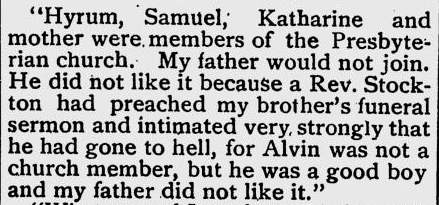
Years later, after two decades of raising kids among this religious conflict, Joseph Sr and Lucy Mack lost their oldest son Alvin in 1823. Joseph Smith Jr was 18 years old at the time, and all of a sudden this salvation debate became very personal. At his funeral, Methodist Reverend Stockton preached that Alvin had gone to hell as he had not been a baptized church member. This did not set well with the Smith family, as Alvin had been a good person who loved God. Fast forward five years, Joseph Jr married Emma, and during the early stages of dictating the Book of Mormon they also lost their first son, born and buried on June 15, 1828.
Amidst all of these tragedies, the Second Great Awakening was happening all around the Smith family, with protestant ministers contending about topics such as this. The salvation of infants and unbelievers who died before being baptized was a heavily debated topic of the Great Awakening. Joseph had much reason to include dialogue about infant loss and premature death into the Book of Mormon to ease the anxious spirits of both his parents and his wife.
1832, Three Degrees of Glory (D&C 76)
Early in 1832, two years after starting the church, Joseph gave a revelation describing the three degrees of heaven, now found in D&C 76. Here is a quick overview of what Joseph taught in D&C 76 about who will go to each of the three Degrees of Glory and what their eternal fate will be.
Sons of Perdition (verses 30-49)
- Partook in the Lord’s power but were overcome by the devil
- Deny the truth and God’s power
- No forgiveness in this world or the world to come
- Denied the Holy Spirit after receiving it
- Only ones to suffer the second death
Celestial Kingdom (verses 50-70, 94-96)
- Had a testimony of Jesus, baptized by immersion
- Kept the commandments, overcame by faith
- Sealed by the Holy Spirit of promise
- Become priests and kings, received the Father’s fullness and glory
- They are Gods, even the sons of God
- Bodies celestial, whose glory is of the sun
- Receive God’s grace
- Made equal to God in power, might and dominion
Terrestrial Kingdom (verses 71-80, 87)
- Died without the law
- Those in spirit prison whom Jesus preached to who did not receive the testimony of Jesus in the flesh, but received it in spirit prison
- Honorable men of the earth who were blinded by the craftiness of men
- Not valiant in the testimony of Jesus
- Receive the presence of the son but not the fulness of the Father
- Bodies terrestrial, glory is that of the moon
- Are ministered to by angels from the Celestial
Telestial Kingdom (verses 81-89, 98-106, 109-112)
- Did not receive the gospel of Christ nor a testimony of Jesus but don’t deny the Holy Spirit
- Thrust down to the hell until the last resurrection
- Receive not God’s fulness
- Are ministered to by angels from the Terrestrial to become heirs of salvation
- People who said they were followers of Paul, Cephas (Peter), Moses, John, and even Jesus, but did not receive the gospel or testimony of Jesus
- Liars, sorcerers, adulterers, etc
- Suffer the wrath of God on earth and the eternal fire
- Cast down to hell until the fulness of times when they will finally bow and confess Jesus is Lord
- Will become God’s servants but will never be allowed be in the presence of God or Jesus
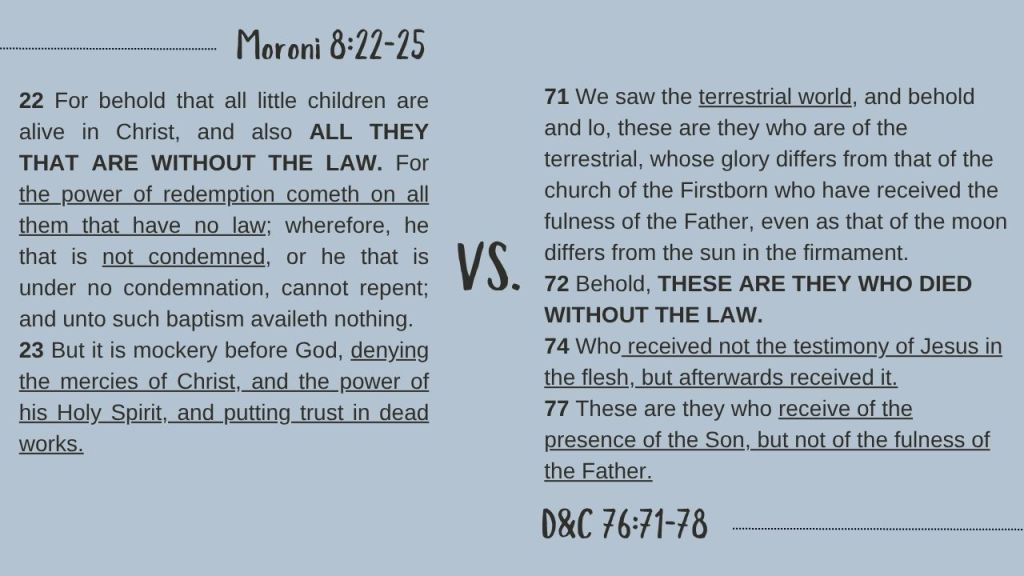
D&C 76 is the first time we see an internal contradiction in Joseph Smith’s canonized teachings on the subject of Salvation for the Dead. In verse 72, Joseph refers to people who died without the law, just like Moroni 8, however D&C 76 explains that those who didn’t accept Jesus on earth but accepted him later in the spirit world will receive only the Terrestrial Kingdom, the second highest glory, in which souls can “receive of the presence of the Son, but not the fulness of the Father,” (D&C 76:77). Does this sound like a loving Heavenly Father? Demoting souls who died prematurely or without the gospel to the Terrestrial Kingdom where he will not visit them? Does that sound like those souls are under no condemnation and are saved by the power of redemption? No, that doesn’t sound like the loving, wise God I know, nor does it sound like those souls are really saved as Moroni 8 says. Nevertheless, this is what Joseph publicly taught from 1831-1836.
– Degrees of Heaven –
Even though Joseph’s revelations often stemmed from a Bible verse or two, like the glories mentioned in 1 Corinthians 15, the context and meaning of the original passage was ignored and twisted to imply something entirely different. To stay on topic I’ll save detailing all the falsehoods taught in Joseph’s interpretation of 1 Corinthians 15 for a separate article. However I will quickly mention that Joseph’s definitions of celestial and terrestrial (and addition of telestial) have nothing to do with what Paul was teaching. Paul spoke of celestial (heavenly) bodies and terrestrial (earthly) bodies. Flesh and spirit, not degrees of heaven.
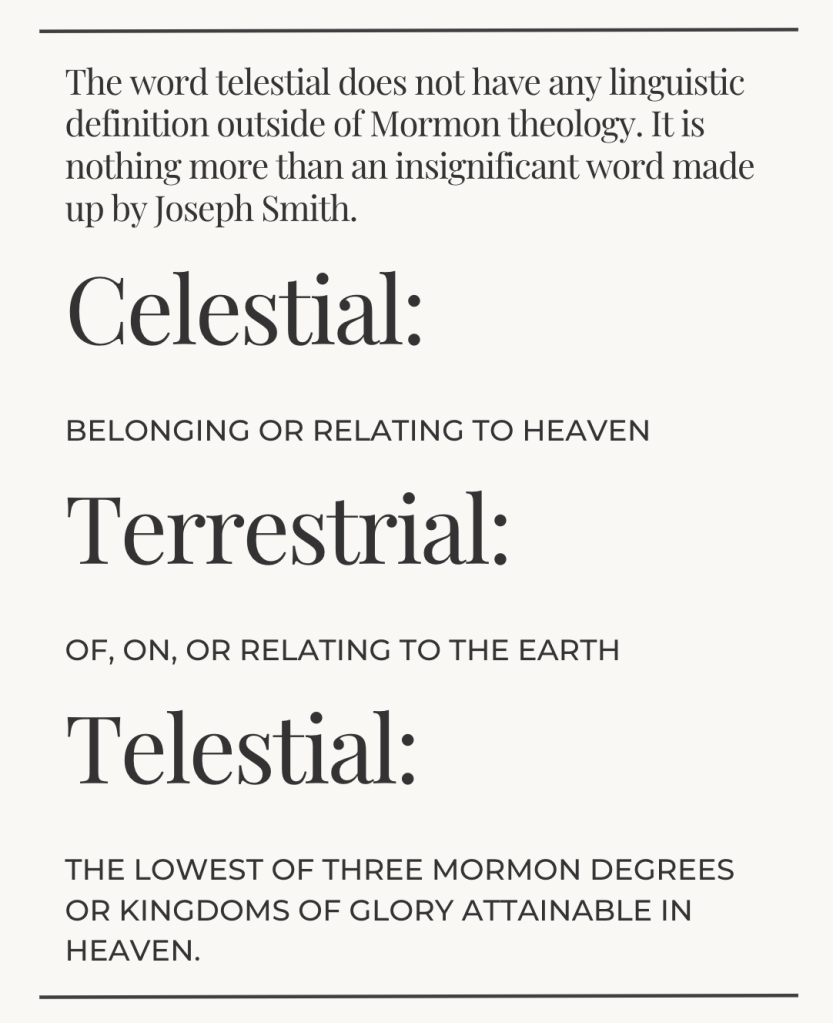
I will say that although not commonly talked about among Christian groups, various levels of heaven is in fact a Biblical concept. Some scriptures do refer to levels of heaven and hell, and one ancient prophet even described up to ten levels of heaven as he saw in vision, recorded in the Apocryphal book of 2nd Enoch. However in this detailed account, the “third heaven” is more descriptive of a purgatory or temporary “spirit world” in LDS theology, not the highest degree of exaltation.
The most peculiar thing I noticed about this Kingdoms of Glory revelation was that rather than starting by describing the afterlife for all the people who will inherit one of the three degrees of glory, Joseph started by first describing the punishment of the small number of souls who will be called Sons of Perdition and receive no forgiveness (D&C 76:31-37). I wondered why he would make this his first point rather than the last. Since God is full of love, mercy and grace, and the vast majority of souls will obtain a Kingdom of Glory, the unforgivable Sons of Perdition are such an extreme outlier and minority — why start there? So I did what I do and searched the JSP and D&C for some historical context to see what events were happening preceding Joseph’s February 1832 revelation (this list of D&C revelations in chronological order was helpful), and I found some interesting insights about what was happening in the church preceding this revelation.
– The First Son of Perdition –
Just months before giving the revelation on the three degrees of glory, the church was faced with a great deal of public scrutiny by a figure I’m calling “The O.G. Ex-Mormon.” Ezra Booth was baptized into the church in May of 1831, formerly a methodist Minister from Ohio, he quickly became a zealous missionary working side by side Joseph Smith. However after witnessing Joseph’s prophecies fail and the absence of purported miraculous healing and raising of the dead, Ezra started to wonder if he had been deceived by a false prophet and false gospel. Amid Ezra’s faith crisis, he began conversing with others such as Isaac Morley about his concerns about the failed prophecies and miracles, and several started to doubt Joseph’s credibility as well. On September 11, 1831 Joseph gave a revelation (D&C 64) warning that “the Lord, will forgive whom [he] will forgive” and stated that Isaac Morley would be forgiven, but was silent on Ezra Booth, implying his trespass was unforgivable.
15 Behold, I, the Lord, was angry with him who was my servant Ezra Booth, and also my servant Isaac Morley, for they kept not the law, neither the commandment;
16 They sought evil in their hearts, and I, the Lord, withheld my Spirit. They condemned for evil that thing in which there was no evil; nevertheless I have forgiven my servant Isaac Morley.
So what did Ezra do that was so unforgivable? Well, following the devastating realization of his own deception in the Mormon church, Ezra wrote 9 letters to a fellow minister friend describing his experiences with the Mormons. These letters were published in the Ohio Star, the first one being published September 12, 1831 and the last December 6, 1831.
At the same time Ezra’s letters were being published, Joseph worked overtime to send more and more missionaries out to combat the negative opinions spreading about his church. In a variety of ways, Joseph reiterated that those who believed his gospel and were baptized would be saved, but those that did not believe would be damned (D&C 68:8-9).
Ezra’s published letters were causing big problems for the church and Joseph wanted the members to believe that he would receive harsh eternal punishment for speaking against “the Lord’s church.” Not long after Ezra’s last letter was published in the Ohio Star, Joseph gave his revelation on the three Degrees of Glory on February 16, 1832. I believe this is why Joseph’s enemies were on the forefront of his mind and why he began his teachings on the afterlife with the description of their eternal torment, specifically those who deny the Holy Spirit after receiving it like Ezra Booth had.
1836, Alvin in the Celestial Kingdom (D&C 137)
Unfortunately for Joseph, in his frustration with Ezra, his Kingdoms of Glory revelation contradicted the Book of Mormon’s teachings on those who die without the law. Though Moroni 8 says they would not be condemned, D&C 76 says they would only inherit the terrestrial (2nd degree) kingdom, where they would not be in God’s presence. It seems this flaw in the three Degrees of Glory doctrine was noticed and people who had lost babies or family members before having the opportunity to join the church may have had more questions. Joseph’s own family evidently questioned Alvin’s eternal fate, because in 1836 Joseph had to reassure the Smith family that Alvin was indeed in the Celestial Kingdom and was not condemned to the Terrestrial Kingdom. That revelation became D&C 137, which clarified that all who died without the gospel, and all deceased children, would be saved in the Celestial Kingdom.
6 And marveled how it was that [Alvin] had obtained an inheritance in that kingdom, seeing that he had departed this life before the Lord had set his hand to gather Israel the second time, and had not been baptized for the remission of sins.
7 All who have died without a knowledge of this gospel, who would have received it if they had been permitted to tarry, shall be heirs of the celestial kingdom of God;
8 Also all that shall die henceforth without a knowledge of it, who would have received it with all their hearts, shall be heirs of that kingdom;
9 For I, the Lord, will judge all men according to their works, according to the desire of their hearts.
10 And I also beheld that all children who die before they arrive at the years of accountability are saved in the celestial kingdom of heaven.
Joseph corrected his 1832 statement on those who die without the law, but the Kingdoms of Glory revelation was not updated to reflect this change. It seems Joseph tried to revert back to his original doctrine which was more aligned with the Bible, verse 9 is important as it states that the reason Alvin was saved in the celestial kingdom is because God judges people according to their works and their hearts. But as the years went on, his revelations got further from the Bible and his own past teachings. So in D&C 137 Joseph corrected his contradiction to the Book of Mormon, but just four years later he would contradict himself again.
1840, The Introduction of Baptism for the Dead
Joseph Smith first introduced the idea of being baptized on behalf of someone who had already passed away at the funeral of Seymour Brunson, in August of 1840. No notes from that funeral service exist, but we have some details about what was taught in Joseph’s December 1840 letter to the England missionaries.
“I presume the doctrine of ‘Baptism for the dead’ has reached your ears, and may have raised some inquiries in your mind respecting the same. I cannot in this letter give you all the information you may desire on the subject, but aside from my knowledge independent of the Bible, I would say, that this was certainly practiced by the ancient churches and St Paul endeavors to prove the doctrine of the resurrection from the same, and says ‘else what shall they do who are baptized for the dead.’ I first mentioned the doctrine in public while preaching the funeral sermon of Bro Seymour Brunson, and have since then given general instructions to the church on the subject. The saints have the privilege of being baptized for those of their relatives who are dead, who they feel to believe would have embraced the gospel if they had been privileged with hearing it, and who have received the gospel in the spirit through the instrumentality of those who may have been commissioned to preach to them while in the prison. Without enlarging on the subject you will undoubtedly see its consistency, and reasonableness, and presents the gospel of Christ in probably a more enlarged scale than some have received it. “
As Joseph starts teaching this new doctrine, he continues to contradict his previous teachings regarding the salvation for the dead. This new idea that deceased people needed to be baptized disagrees with prior revelations regarding those who didn’t have the opportunity to accept the gospel on earth. Four years prior Joseph had said that all those like Alvin who would have accepted the gospel if they had a chance would inherit the celestial kingdom. Now the LDS explanation for this is that D&C 137 was foreshadowing the practice of baptism for the dead, but this cannot be true since verse 9 told us that Alvin was saved because God judged his heart, not his baptism status. Moroni 8 and D&C 137 describe two categories of people who will be saved in the celestial kingdom: those who die without the law, and little children. But in 1840 Joseph got the absurd idea that although both groups are pre-qualified for salvation, some of them still needed a mortal transaction through water by proxy.
internal contradictions on baptism for the dead:
- All little children are alive in Christ, and also all they that are without the law. For the power of redemption cometh on all them that have no law; wherefore, he that is not condemned, or he that is under no condemnation, cannot repent; and unto such baptism availeth nothing. (Moroni 8:22-25)
- All who have died without a knowledge of this gospel, who would have received it if they had been permitted to tarry, shall be heirs of the celestial kingdom of God. (D&C 137:7)
- The saints have the privilege of being baptized for those of their relatives who are dead, who they feel to believe would have embraced the gospel if they had been privileged with hearing it. (Joseph Smith 1840 letter)
Joseph’s claim that the early church practiced baptism for the dead contradicts Jesus’s own teachings in the four gospels. In Luke 9 Jesus invites someone to follow him who says their father had just died and they needed to bury him first. If baptism for the dead was a true principle, don’t you think Jesus would have taken this perfect opportunity to offer this man salvation for his father through proxy baptism? However he responded very differently. Jesus tells the man to let the dead bury the dead and focus on proclaiming the kingdom of God to the living!
59 Then He said to another man, “Follow Me.” The man replied, “Lord, first let me go and bury my father.”
60 But Jesus told him, “Let the dead bury their own dead. You, however, go and proclaim the kingdom of God.”
– The Dead Cannot Repent –
The concept of people receiving the gospel in the spirit world and accepting a proxy baptism done by a qualified LDS friend or family member makes room for the possibility of repenting after death. Not only is this in opposition to Biblical scripture that states that no work can be done in the afterlife, but it contradicts Joseph’s previous theology in the Book of Mormon and what he would declare two years later in Article of Faith number four. Since repentance is a prerequisite to baptism, and the dead cannot repent, they also cannot accept baptism.
Biblical & internal contradictions on the dead repenting:
- Whatever your hand finds to do, do it with your might; for there is no work or device or knowledge or wisdom in the grave where you are going. (Ecclesiastes 9:10)
- I must work the works of Him who sent Me while it is day; the night is coming when no one can work. (John 9:4)
- Do not procrastinate the day of your repentance until the end; for after this day of life, which is given us to prepare for eternity, behold, if we do not improve our time while in this life, then cometh the night of darkness wherein there can be no labor performed. Ye cannot say, when ye are brought to that awful crisis, that I will repent, that I will return to my God. (Alma 34:33-34)
– 1 Corinthians 15 –
As Joseph had mentioned in his 1840 letter to the England missionaries, he believed Paul taught the principle of baptism for the dead in 1 Corinthians 15:29. I have a separate article called What Paul Really Taught About the Resurrection in 1 Corinthians 15 (link coming soon) with much more detail breaking down the chapter verse by verse revealing the true nature of his message regarding resurrection, bodies and glories, but I’ll keep this part focused on baptism for the dead. As Paul mentions in the beginning of the chapter, he was addressing some people who did not believe in the resurrection of the dead.
“Now if Christ be preached that he rose from the dead, how say some among you that there is no resurrection of the dead?” (1 Corinthians 15:12)
It’s important to know that Corinth is a city in Greece, not far from Athens, the home of many famous pagan philosophers like Socrates, Plato and Aristotle who lived just a few hundred years before Jesus. This is significant because these philosophers had great influence on society, and still do today! While Aristotle believed that the soul is attached to the body and dies with it, Socrates and Plato both believed in reincarnation. Plato specifically taught that humans could reincarnate as different species based on the merit of their lives. So Paul wasn’t just talking to people who disbelieved in resurrection, he was talking to people who believed in reincarnation.
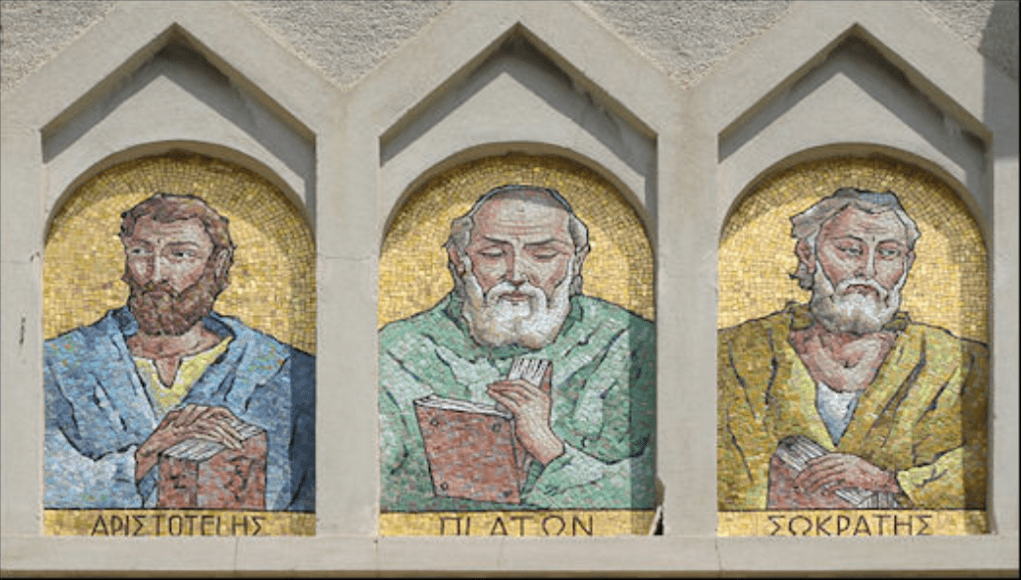
It seems the believers in Corinth were still influenced by their societal philosophies and were confused about the state of the soul after death, not just their own soul but also Jesus’s. Paul spends the bulk of verses 12-28 testifying of the reality of Jesus’s resurrection and declaring that if Jesus wasn’t resurrected their faith was in vain, so how could they disbelieve the resurrection? Then comes the infamous verse 29, pay attention to the verses that come after and see if it sounds like something Paul agrees with or disagrees with.
29 Else what shall they do which are baptized for the dead, if the dead rise not at all? Why are they then baptized for the dead?
30 And why stand we in jeopardy every hour?
31 I protest by your rejoicing which I have in Christ Jesus our Lord, I die daily.
32 If after the manner of men I have fought with beasts at Ephesus, what advantageth it me, if the dead rise not? Let us eat and drink; for to morrow we die.
33 Be not deceived: evil communications corrupt good manners.
34 Awake to righteousness, and sin not; for some have not the knowledge of God: I speak this to your shame.
Of course we don’t know exactly what the situation in Corinth was like, and who and why they were baptizing the dead, but I see three possible scenarios based on the context to which Paul could have been speaking to the people of Corinth.
- Some believers were baptizing their dead and Paul was telling them to stop.
- Immediately after mentioning baptism for the dead, in verses 30-34 Paul relates it to standing in jeopardy, he protests, warns them not to be deceived, then calls them to wake up and stop sinning.
- Pagans among the believers were baptizing their dead perhaps thinking that it could help them in their next reincarnation.
- Paul challenged the societal philosophy of human-to-animal reincarnation in verses 37-39, illustrating people will remain in the same physical form in the resurrection, just as a seed only grows into the plant from which it came. He says a wheat grain will only grow into wheat, to each it’s own–as is the resurrection. A human will resurrect as a human.
- From verses 11-28 Paul uses the inclusive word we in reference to the believers and what true principles they should stand on. But when it comes to verse 29 he says they, making a distinction from us and them who were doing this.
- Paul is speaking metaphorically comparing death to sin, asking why are they even baptized for forgiveness of sin and salvation if they’re not going to come back from the dead.
- Paul uses death as a metaphor for sin multiple times in the chapter. Verses 17-18 say if Christ was not raised we are still in our sins and perish (physical & spiritual death). Paul says in verse 31 that he “dies daily,” did he actually physically die daily? No, but he sinned daily. And verse 56 says the sting of death is sin.
One or more of these scenarios could be true at the same time. But one thing is for sure, Joseph’s claim that Paul was “endeavoring to prove the doctrine of the resurrection” by teaching the practice of proxy baptism has zero contextual basis and is absolutely not true. Paul did not in any way promote the practice of proxy baptism, rather he was calling out the people’s flawed logic and lack of understanding of the gospel. (See the Related Videos at the end of this article for more discussion on 1 Corinthians 15).
1841, Temples Required for Baptism for the Dead (D&C 124)
One of the biggest problems in Joseph’s Baptism for the Dead doctrine is that it became dependent on temples. If you haven’t yet dove into the contradictions with modern day temple worship, I will soon publish articles on the doctrinal contradictions with temples, but for now you can refer to the Ex-Mormon Bible Study videos at the end of this article. Since the beginning of the church Joseph had instructed his people to build temples. In July 1831, Joseph prophesied of building Zion’s temple in the promised land located in Jackson County Missouri.
“Wherefore, this is the land of promise, and the place for the city of Zion. And thus saith the Lord your God, if you will receive wisdom here is wisdom. Behold, the place which is now called Independence is the center place; and a spot for the temple is lying westward, upon a lot which is not far from the courthouse.” (D&C 57:2-3)
Although early on Joseph had designated Missouri as the land of their inheritance and the place for Zion’s temple, the ground was never broken on the temple lot. After years of trying to settle in Jackson County they were eventually driven out. Meanwhile, church headquarters were still in Kirtland, Ohio and in 1833 Joseph instructed a “house of God” to be built there (D&C 88:119), it was completed in 1836. Although the canonized D&C may only refer to the Kirtland temple as a “house of God,” Joseph’s journals do refer to it as a temple. He gave the highly controversial Missouri “Temple Lot” it’s name and wrote entries about the women sewing the “veil of the temple” for the Kirtland temple. (You can follow that link to Joseph’s 1834-1836 journal and use the “find” function to see all his mentions of the word temple.)
After plans to build the temple in Independence/Jackson County were foiled, Joseph gave a revelation in 1838 to build the temple in Far West, Missouri, about 50 miles north. However just three months after laying the corner stones, the people were tragically massacred at Hans Mill which not only ended construction of the temple, but also ended their time in Missouri for good. After the Mormons were ran out of both Ohio and Missouri in the late 1830’s, the church relocated to Commerce (renamed Nauvoo), Illinois.
For the first couple of years as members relocated to Nauvoo, there was not much talk of temples. It wasn’t until two months after beginning the practice of baptism for the dead that Joseph announced at General Conference that a temple should be built in Nauvoo. In January of 1841 Joseph gave a revelation that not only instructed the people to start building the temple, but also added a new critical detail: the necessity of a temple baptismal font to perform baptisms for the dead. Although never mentioned in the planning of the first three temples, this new requirement was explicitly commanded in D&C 124:29.
Before I dissect the contents of D&C 124 I’d just like to comment on the very unorganized nature of early Mormon temple building. In the first eight years God had allegedly commanded two temples to be built in Missouri that ended in failure. And now in Nauvoo, he commands the people to practice a sacred ordinance that must be done in a temple before having a temple. These events just do not add up with the pattern and promises God has shown us in the Bible. God is a God of order (1 Corinthians 14:33), and what he plans will happen (Isaiah 14:24, Ezekiel 12:25). The history of early Mormon temple building does not display the Godly attributes of order and fulfilment of plans and promises, I’d argue that His hand was not in it.
D&C 124 is a very long section with many doctrinal points and restoration claims. I will break down the doctrinal claims and Biblical contradictions by topic.
– God Commands Building Temples –
In D&C 124:26-31, Joseph Smith said that God needed a temple made with gold, silver and precious stones to dwell in:
26 Come ye, with all your gold, and your silver, and your precious stones, and with all your antiquities; and with all who have knowledge of antiquities, that will come, may come, and bring the box tree, and the fir tree, and the pine tree, together with all the precious trees of the earth; and with iron, with copper, and with brass, and with zinc, and with all your precious things of the earth; and build a house to my name.
27 …Build a house to my name, for the Most High to dwell therein.
31 But I command you, all ye my saints, to build a house unto me.
Although temples were a central part of Old Testament worship, the New Testament says that God does not dwell in temples made with hands. Jesus prophesied the destruction of the temple describing all the stones being thrown down and told the woman at the well that the time was now that people did not need to worship in those designated places at Jerusalem or the mountain.
Biblical contradictions with temple worship under the new covenant:
- God that made the world and all things therein, seeing that he is Lord of heaven and earth, dwelleth not in temples made with hands. (Acts 17:24)
- As he went out of the temple, one of his disciples saith unto him, Master, see what manner of stones and what buildings are here! And Jesus answering said unto him, seest thou these great buildings? There shall not be left one stone upon another, that shall not be thrown down. (Mark 13:1-2)
- Jesus saith unto her, woman, believe me, the hour cometh, when ye shall neither in this mountain, nor yet at Jerusalem, worship the Father. Ye worship ye know not what: we know what we worship: for salvation is of the Jews. But the hour cometh, and now is, when the true worshippers shall worship the Father in spirit and in truth. (John 4:21-23)
– Playing Savior –
Another blasphemous idea that Joseph taught while explaining the details of baptism for the dead is that the salvation of others is dependent on us, or sometimes our salvation is dependent on others. In urging the saints to finish the temple quickly he said God would not accept their baptisms for the dead in the river after a certain timeframe. Joseph suggested that their personal failure to finish the temple in time would condemn not only them but also their friends and family for whom they had already been proxy baptized for.
“But behold, at the end of this appointment your baptisms for your dead shall not be acceptable unto me; and if you do not these things at the end of the appointment ye shall be rejected as a church, with your dead, saith the Lord your God.” (D&C 124:32)
Just think about that insane ultimatum. Can you truly imagine God welcoming late Grandpa Bobby into heaven after his grandson had been proxy baptized for him, then later saying “you know what, your grandson didn’t finish that temple in time so now you’re both condemned.” No! The Bible says that salvation is individual, no one can earn it for you or take it away from you! Jesus Christ is the only mediator and savior, he alone can save, but at the end of this article we will see Joseph Smith plainly state that “you can be a savior” for deceased friends and family.
Remember the Bible verses about God’s judgement laid out in the beginning of this article, this ultimatum to finish the temple in time contradicts God’s gracious nature and just judgement. It appears Joseph may have been using this ultimatum as a way to create urgency in building the Nauvoo temple, as the people may have had low motivation to spend their energy and resources building yet another temple that could very well end in another failure.
Biblical contradictions on saving or condemning others:
- For the Son of Man will come in the glory of His Father with His angels, and then He will reward each according to his works. (Matthew 16:27)
- For we must all appear before the judgment seat of Christ, that each one may receive his due for the things done in the body, whether good or bad. (2 Corinthians 5:10)
- For by grace you have been saved through faith; and that not of yourselves, it is the gift of God. Not as a result of works, so that no one may boast. (Ephesians 2:8-9)
- For there is one God and one Mediator between God and men, the Man Christ Jesus. (1 Timothy 2:5)
I remember as a fully believing Latter Day Saint I felt a sense of self-importance when I took family names to the temple to do their work. Because of me those souls could finally enter paradise. Now I realize how foolish it was to boast of my own “good works.” No human can mediate for another. Jesus is the only mediator between us and God. We can’t help anyone in the spirit world by being baptized on their behalf and no one will be rejected because we didn’t do enough.
This focus on doing baptisms and temple work for the dead has become a major distraction from the kingdom work Jesus showed us. He said the kingdom is now, it’s here on earth with the people around us everyday, and we’re missing it by doing futile busy work for the dead. Some members spend hours each week searching their genealogies and preparing names for the temple. This sounds exactly like what Paul wrote in 1 Timothy 1, warning of false doctrines, fables and endless genealogies.
3 I urged you… that you may charge some that they teach no other doctrine,
4 Nor give heed to fables and endless genealogies, which cause disputes rather than godly edification which is in faith.
– This Ordinance Belongs to My House –
Not only did Joseph claim that God commanded a temple, but that it must be built with gold, silver and precious stones for God to dwell in. He also claimed that the ordinance of baptism for the dead has always belonged to the House of God since the beginning of the world.
29 For a baptismal font there is not upon the earth, that they, my saints, may be baptized for those who are dead—
30 For this ordinance belongeth to my house, and cannot be acceptable to me, only in the days of your poverty, wherein ye are not able to build a house unto me.
33 For verily I say unto you, that after you have had sufficient time to build a house to me, wherein the ordinance of baptizing for the dead belongeth, and for which the same was instituted from before the foundation of the world, your baptisms for your dead cannot be acceptable unto me;
Just as Joseph had said that he believed the apostle Paul taught baptism for the dead, in D&C 124 he also started to imply that this was always practiced in God’s temples since the time of Moses.
36 For it is ordained that in Zion, and in her stakes, and in Jerusalem, those places which I have appointed for refuge, shall be the places for your baptisms for your dead.
37 And again, verily I say unto you, how shall your washings be acceptable unto me, except ye perform them in a house which you have built to my name?
38 For, for this cause I commanded Moses that he should build a tabernacle, that they should bear it with them in the wilderness, and to build a house in the land of promise, that those ordinances might be revealed which had been hid from before the world was.
39 Therefore, verily I say unto you, that your anointings, and your washings, and your baptisms for the dead, and your solemn assemblies, and your memorials for your sacrifices by the sons of Levi, and for your oracles in your most holy places wherein you receive conversations, and your statutes and judgments, for the beginning of the revelations and foundation of Zion, and for the glory, honor, and endowment of all her municipals, are ordained by the ordinance of my holy house, which my people are always commanded to build unto my holy name.
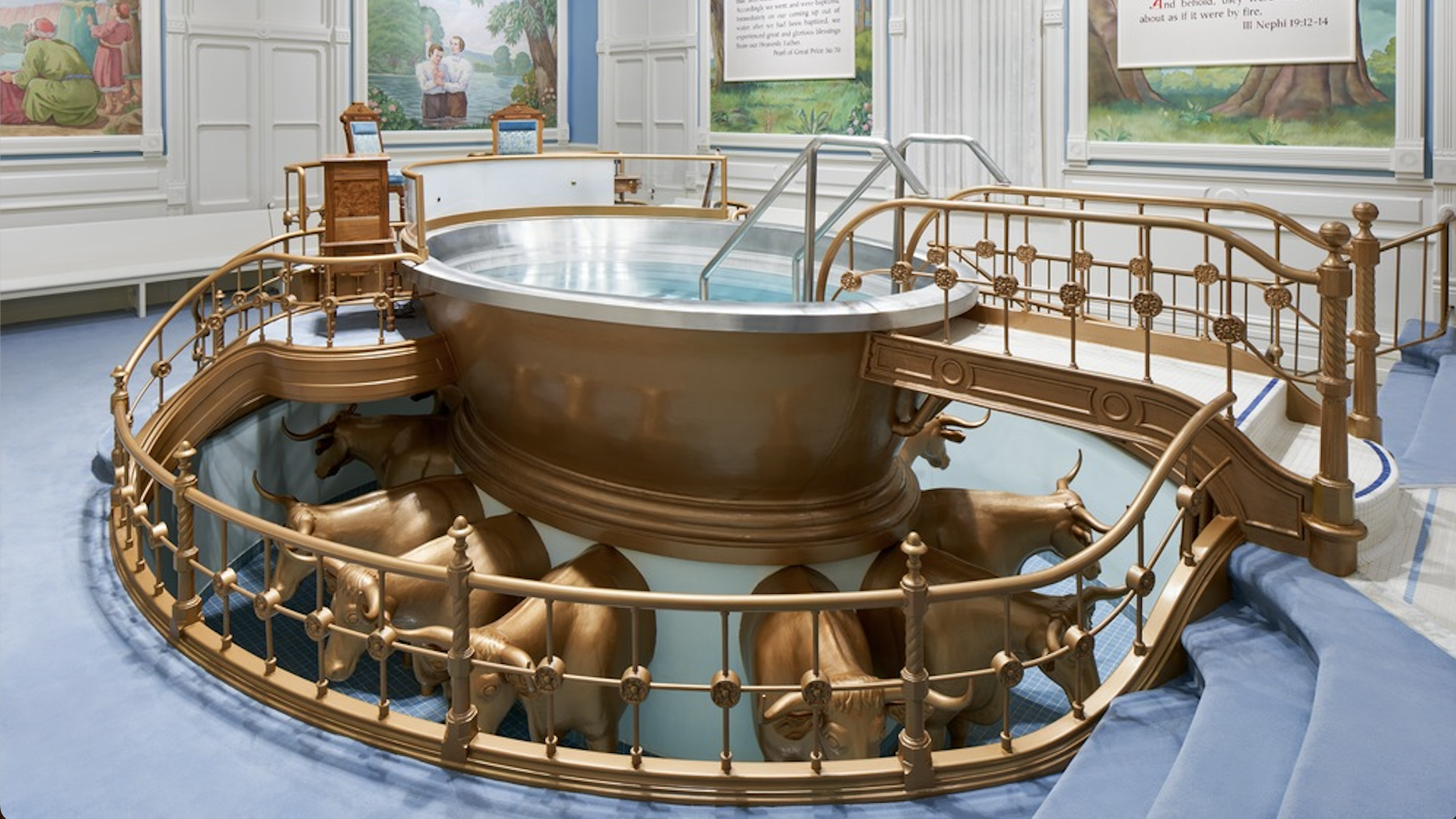
Verses 38-39 are the key points here, where Joseph said God commanded Moses to build the tabernacle (which preceded the temple) for the ordinances including baptism for the dead. To support his idea that baptism from the dead was first established by Moses and practiced in Solomon’s temple, Joseph based the design of the temple baptismal font off of the “Brazen Sea” of Solomon’s temple. Local leaders described the baptismal font as “resting upon the twelve oxen… they are ingeniously carved, and strikingly resemble the living original; and the Baptismal Font, I should judge from what is said in the bible, strongly resembles the Brazen Sea” (letter from Branch President Winchester, page 605).
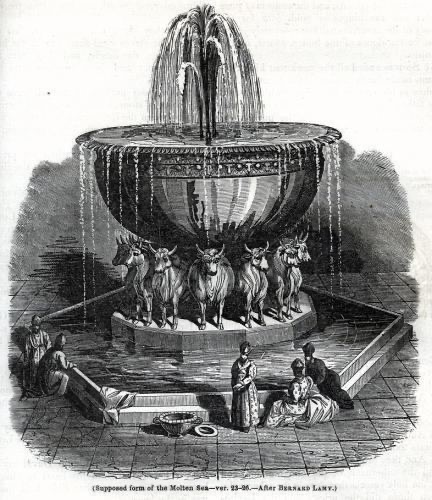
One big issue with replicating this model is that the Brazen Sea (or Molten Sea) was not a baptismal font at all, it was a 30 foot tall, 7.5 foot deep basin of water used for the priest’s hand washing before performing sacrifices (Exodus 30:18-21, 2 Chronicles 4:2-6). This Brazen Sea is an interesting and contradictory detail for Joseph to fixate on given that the sacrifices & ordinances of the Law of Moses had been fulfilled by Jesus and done away with. This article has much more information on the Brazen Sea including Biblical references on it’s appearance and purpose.
Though the ordinance of baptism was not instituted until John the Baptist, I’ve heard some LDS members claim that the ritualistic washings were the same thing. One such claim was widely published by Bruce R McConkie (Mormon Doctrine, page 74) who claimed that baptisms were performed in the Brazen Sea. However the priests’ hand and foot washing with water from the Brazen Sea was very different than the ritual purification washings called Tevilah. Tevilah was practiced by all Jews, not only priests, by immersing one’s body in a body of “living water” called a Mikvah, namely a natural spring, or collected rain water. For example the pool in the outer courts of the temple was a collection of rain water and spring water. A person was required to undergo Tevilah if they were deemed ritually unclean, such as coming in contact with a dead body or after menstruation. The ritual of Tevilah was not officiated by the priesthood nor was it required to happen in the temple, the only requirement was that it was oversaw by an adult to confirm that full body immersion had been completed.
1842, Letters From Hiding (D&C 127 & 128)
While in hiding to evade arrest in 1842, Joseph wrote two letters to the church which became D&C 127 and 128, giving more detailed instruction on the practice of baptism for the dead. While this doctrine had already sounded like Jesus’s atonement was not sufficient to judge graciously, this is where Joseph really doubles down and quotes more Bible verses out of context to try to support his idea. Congruent with his previous teaching that “for this cause [God] commanded Moses that he should build a tabernacle,” (D&C 124:38), he explains in D&C 128 that the ordinance of baptism for the dead was God’s plan instituted before the foundation of the world to save all souls who die without the gospel and says that our ancestors cannot be made perfect without us doing this ordinance for them.
5 The ordinance and preparation that the Lord ordained and prepared before the foundation of the world, for the salvation of the dead who should die without a knowledge of the gospel.
15 For their salvation is necessary and essential to our salvation, as Paul says concerning the fathers—that they without us cannot be made perfect—neither can we without our dead be made perfect.
16 And now, in relation to the baptism for the dead, I will give you another quotation of Paul, 1 Corinthians 15:29: Else what shall they do which are baptized for the dead, if the dead rise not at all? Why are they then baptized for the dead?
18 The earth will be smitten with a curse unless there is a welding link of some kind or other between the fathers and the children, upon some subject or other—and behold what is that subject? It is the baptism for the dead. For we without them cannot be made perfect; neither can they without us be made perfect.
The phrase “they without us [should not] be made perfect” comes from Hebrews 11. This chapter presents a long list of ancient Biblical figures like Noah, Enoch, Abraham, Isaac, Sarah, and Moses sharing their stories of faith (in an eerily similar format to Ether 12), and at the end it says they have not yet received “the promise” and should not “be made perfect without us.” You may want to pause and read Hebrews 11 for context here, but here’s a synopsis:
“Now faith is the substance of things hoped for, the evidence of things not seen. By faith Enoch was translated… By faith Noah prepared an ark… By faith Abraham went out not knowing whither he went… And these all, having obtained a good report through faith, received not the promise: God having provided some better thing for us, that they without us should not be made perfect.” (Hebrews 11)
Now Joseph quoting this passage in reference to baptisms for the dead is interesting. He says that our ancestors cannot be made perfect without us (suggesting they need us to do their proxy baptism so they can enter heaven), but how can that be if Hebrews chapter 11 is about all the ancient prophets and spiritual giants? If Joseph is implying Hebrews 11:39-40 is referring to the salvation of the dead through proxy baptism, is he suggesting that Paul taught the early church to be proxy baptized for the ancient prophets listed in that chapter? It’s very hard to imagine that all the faithful people mentioned in Hebrews 11 were not accepted into heaven (or spirit paradise) yet because they had not been baptized by proper authority during their lifetimes. The chapter never mentions people who died without the law or baptism at all, so how can Joseph possibly quote this chapter to teach baptism for the dead?
To clear things up, what Paul was saying about the Old Testament believers was that they had not received their full inheritance yet because the final judgement, resurrection and transformation of the earth has not happened yet. This is clarified in the original Greek and other translations of the Bible where “without us” is more correctly translated “together with, not apart from.” So it should more accurately read “they together with us shall be made perfect,” meaning we will all receive the heavenly inheritance at the same time at the resurrection.
Continuing on with D&C 128, Joseph also conflated this Hebrews 11 passage with the Malachi 4 prophecy. He misquoted Malachi to say that he prophesied of a “welding link” and claimed that Malachi’s prophecy and Paul’s vague sentence were both really pointing to baptism for the dead.
17 And again, in connection with this quotation I will give you a quotation from one of the prophets, who had his eye fixed on the restoration of the priesthood, the glories to be revealed in the last days, and in an especial manner this most glorious of all subjects belonging to the everlasting gospel, namely, the baptism for the dead; for Malachi says, last chapter, verses 5th and 6th: Behold, I will send you Elijah the prophet before the coming of the great and dreadful day of the Lord: And he shall turn the heart of the fathers to the children, and the heart of the children to their fathers, lest I come and smite the earth with a curse.
18 The earth will be smitten with a curse unless there is a welding link of some kind or other between the fathers and the children, upon some subject or other—and behold what is that subject? It is the baptism for the dead. For we without them cannot be made perfect; neither can they without us be made perfect.
It is interesting that he did not give a scriptural reference when quoting Hebrews 11, he gave references for 1 Corinthians 15 and Malachi 4, so why not this one? Perhaps he knew that although the phrase “they without us cannot be made perfect” sounded nice with his theology, the context of the quoted chapter did not support his claim.
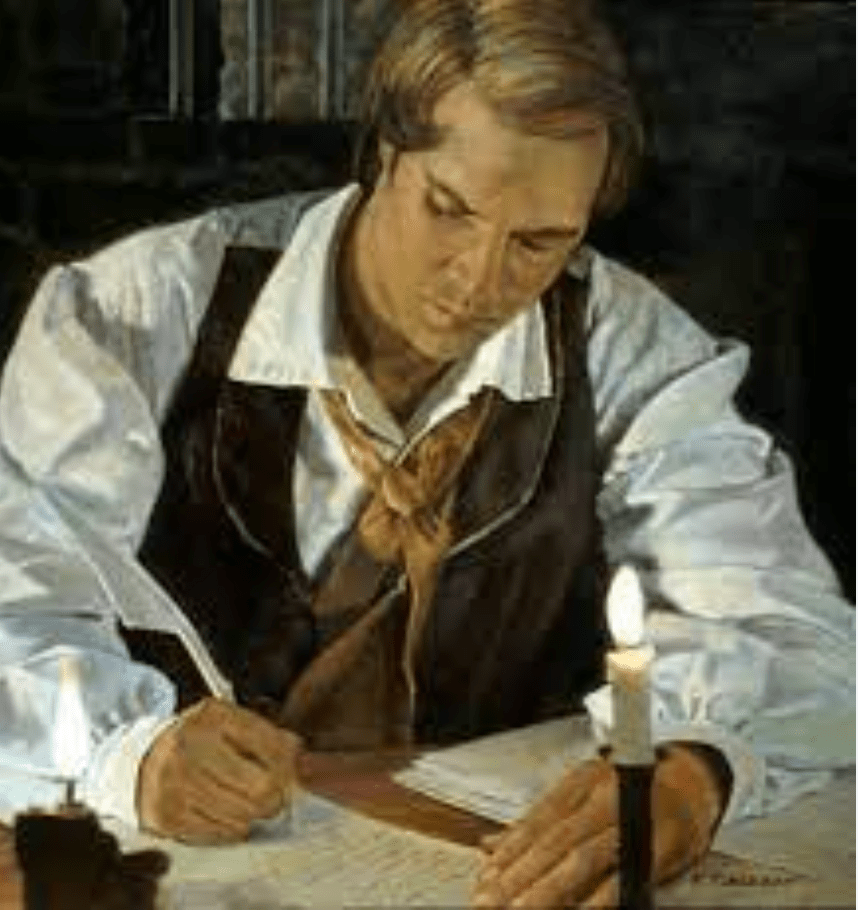
But why did all this new information about Biblical figures teaching baptism for the dead come out two years after they had already been practicing it? By 1842 Joseph’s church was falling apart. Rumors and conspiracy about polygamy were spreading like wildfire due to the situation with John C Bennett, Joseph was in and out of jail and hiding to evade arrest after the attempted murder of Governor Boggs, and accusations of Joseph being a false prophet were increasing. While in hiding, all he could do to try to maintain membership was write letters, encouraging the church to keep the faith in his gospel. One way to keep people loyal was to embellish his theology with more purported fulfillment of prophecy, because if the people were convinced his doctrine was truly prophetic they would remain faithful. This is what I see happening with this letter that became D&C 128, Joseph retroactively inserting claims of fulfillment of prophecy into the baptism for the dead doctrine to keep his people believing that he was doing God’s work.
1844, King Follett Discourse
Just months before he died, Joseph gave a sermon at General Conference following the death of Elder King Follett known as the King Follett Discourse. Because it was not canonized, many Mormons disregard it or even believe it was fraudulently attributed to Joseph Smith. However I find it very compelling that Joseph had four scribes taking notes of his sermon, after his death those notes were compiled to comprise his original sermon. Four scribes, four witnesses, four sources. That’s the same number of gospels we have written about Jesus’s life: Matthew, Mark, Luke and John. The Bible says “by two or three witnesses every word will be established” (Matthew 18:16) and here we have four, that’s more than enough to be confident that this sermon did in fact come from Joseph Smith. In his sermon he continues his plea for the people to save their dead because “they without us cannot be made perfect,” claiming it is the greatest responsibility in this world for us to be saviors for our dead. At the end of the first paragraph we see his motive and desperate attempt to save the people’s faith in himself as a prophet. And by the end we see his final attempt to discredit and condemn those who step away from his church.
Hence the responsibility, the awful responsibility, that rests upon us in relation to our dead; for all the spirits who have not obeyed the Gospel in the flesh must either obey it in the spirit or be damned. Solemn thought!—dreadful thought! Is there nothing to be done?—no preparation—no salvation for our fathers and friends who have died without having had the opportunity to obey the decrees of the Son of Man? Would to God that I had forty days and nights in which to tell you all! I would let you know that I am not a “fallen prophet.”
The greatest responsibility in this world that God has laid upon us is to seek after our dead. The apostle says, “They without us cannot be made perfect”; for it is necessary that the sealing power should be in our hands to seal our children and our dead for the fulness of the dispensation of times…
God has wrought out a salvation for all men, unless they have committed a certain sin; and every man who has a friend in the eternal world can save him, unless he has committed the unpardonable sin. And so you can see how far you can be a savior.
All sins shall be forgiven, except the sin against the Holy Ghost; for Jesus will save all except the sons of perdition. What must a man do to commit the unpardonable sin? He must receive the Holy Ghost, have the heavens opened unto him, and know God, and then sin against him. After a man has sinned against the Holy Ghost, there is no repentance for him. He has got to say that the sun does not shine while he sees it; he has got to deny Jesus Christ when the heavens have been opened unto him, and to deny the plan of salvation with his eyes open to the truth of it; and from that time he begins to be an enemy. This is the case with many apostates of The Church of Jesus Christ of Latter-day Saints…
I advise all of you to be careful what you do, or you may by-and-by find out that you have been deceived. Stay yourselves; do not give way; don’t make any hasty moves, you may be saved… The man who tells you words of life is the man who can save you. I warn you against all evil characters who sin against the Holy Ghost; for there is no redemption for them in this world nor in the world to come.
In the last four years of his life, we can see Joseph’s desperate endeavor to maintain membership in his church by fabricating a false sense of purpose through baptism for the dead. By convincing the early Mormons that they would be sent to outer darkness if they left the church, and creating meaningful purpose in saving their deceased loved ones, Joseph affectively employed two completely false doctrines to keep people loyal and devoted. His counterfeit contradictory theology has kept generations of Mormons distracted performing perpetual dead works, blind to the true grace and mercy of God.
 Ex-Mormon Bible Study
Leave a comment