

An Ex-Mormon Christian’s Perspective
If you are a Christian ministering to people in the Mormon faith, or if someone you love is a member of the LDS church and you’d like to understand how to have more productive religious conversations with them, this article is for you.
As Christians, we love our Mormon friends and family, we care about them and want to share the pure love of Jesus with them. We see the flaws and falsehoods in the LDS gospel and pray that they will see it too. As a previous member of the LDS church who now ministers to current members, I want to share a bit of what I’ve learned are affective approaches as well as ineffective talking points. In this article I will explain why we should first seek to find common ground with our Mormon friends if we want to reach them at all. If we start with our differences, they will immediately put up their defenses and the conversation will be fruitless, or worse, contentious.
I see too many Christians creating animosity between themselves and their Mormon friends by accusing them of not being Christian. Though I completely understand why they say this, we have got to stop saying that Mormons aren’t Christian and that Mormons believe in a different Jesus. I know, I know, don’t come after me just yet. Hear me out. As an ex-Mormon Christian I agree there are major differences regarding the nature of Jesus as taught in LDS doctrine compared to the Bible, but please let me help you see past this list of differences so you can focus on the individual you’re talking to.
The “Mormon Jesus”
Eternal vs. Created
- Biblical Jesus: Eternal, uncreated, and the very God through whom all things were made (John 1:1, 14; Colossians 1:16–17).
- Mormon Jesus: The literal spirit-child of Heavenly Father and Heavenly Mother, a being who came into existence and progressed to godhood after being selected as Savior of the world from among other candidates (Topics and Questions, Premortality).
Nature of God
- Biblical Jesus: Fully God and fully man, he is one with the Father in essence (Philippians 2:5–11; John 10:30).
- Mormon Jesus: One member of the three-being Godhead, individually distinct in substance from the Father, who Himself was once a mortal man that became exalted (Do Members of The Church of Jesus Christ of Latter-day Saints Believe in the Trinity?)
Unique Son vs. Spirit Brother
- Biblical Jesus: The only-begotten (translated unique) Son of God, absolutely unique and not on the same level as created beings (John 3:16).
- Mormon Jesus: Seen as the elder spirit brother of all humans, even the spirit brother of Lucifer (Topics and Questions, “Premortality“).
Salvation VS. Exaltation
- Biblical Jesus: His finished work on the cross is sufficient and final for salvation (John 19:30; Hebrews 10:10–14).
- Mormon Jesus: Salvation requires faith in Him, plus priesthood ordinances, temple rituals and obedience to LDS laws and covenants. Worthy LDS members who complete all the priesthood and temple rituals can be Exalted, that is to become a God themselves (“Becoming Like God,” Gospel Topic Essays).
One Gospel vs. Another Gospel
- The Apostle Paul warned against “another Jesus” and “another gospel.” Mormon doctrine fits this warning—presenting a Jesus who is not the eternal God of the Bible but a redefined figure who cannot save (2 Corinthians 11:4; Galatians 1:6–9).
While I agree with the theological differences presented here, please consider why a list of the institution’s doctrinal differences is far less important than the individual’s personal testimonies. I strongly believe that some Mormons can be Christians, to the extent that they understand Christ. This is not a statement about the LDS organization as a whole but about individual members who, despite the false doctrines they’ve been taught, have real faith in the Jesus of the New Testament. They believe Jesus of Nazareth is their Savior, they have just been lied to about how He saves them.
Intention vs Deception
The reason that aforementioned list of differences should not be our focus of conversation is because most of the things on that list are not foundational aspects of individual Mormon’s faith in Jesus. When they pray, they pray to God in the name of Jesus Christ. They’re not thinking about “Jesus who is the brother of Satan,” they’re thinking about Jesus who created all things in heaven and earth. They’re not thinking about “the created Jesus who progressed to godhood,” they’re thinking about the Son of God who died on the cross for their sins. Mormons know about the same Jesus we do, but their understanding of Him is skewed by the lens of LDS doctrines falsely attributed to him.

This Mormon lens is like a pair of sunglasses making everything a different hue than reality. We can be looking at the same Bible or the same painting of Jesus, and though we can see the same characteristics of divinity, mercy and grace, they see it behind a dark shade of religiosity. They believe in temples because they’ve been told Jesus established temples. They believe in their prophet and priesthood because they’ve been told Jesus’s church requires that structure. They believe in the Book of Mormon because they’ve been told it’s a true history of Jesus. They believe every line of false doctrine because the deceivers have told them “Jesus said so.” And in a quiet room they’re told “don’t you feel that stillness and peace? That’s the Holy Ghost and he’s telling you this is true.”
These false doctrines are the lenses Mormons see through when they envision Jesus. No doctrinal argument will ever remove their “LDS colored glasses,” only the Holy Spirit can remove the scales from their eyes. Arguing about their faith in Jesus creates more animosity between them and Christianity. But discussing the false doctrines that are polluting their understanding of Jesus’ gospel creates more room for spiritual growth. We don’t need to argue about their faith in Jesus, we need to help them lean into their relationship with Jesus because He is the only one who can pull them out!
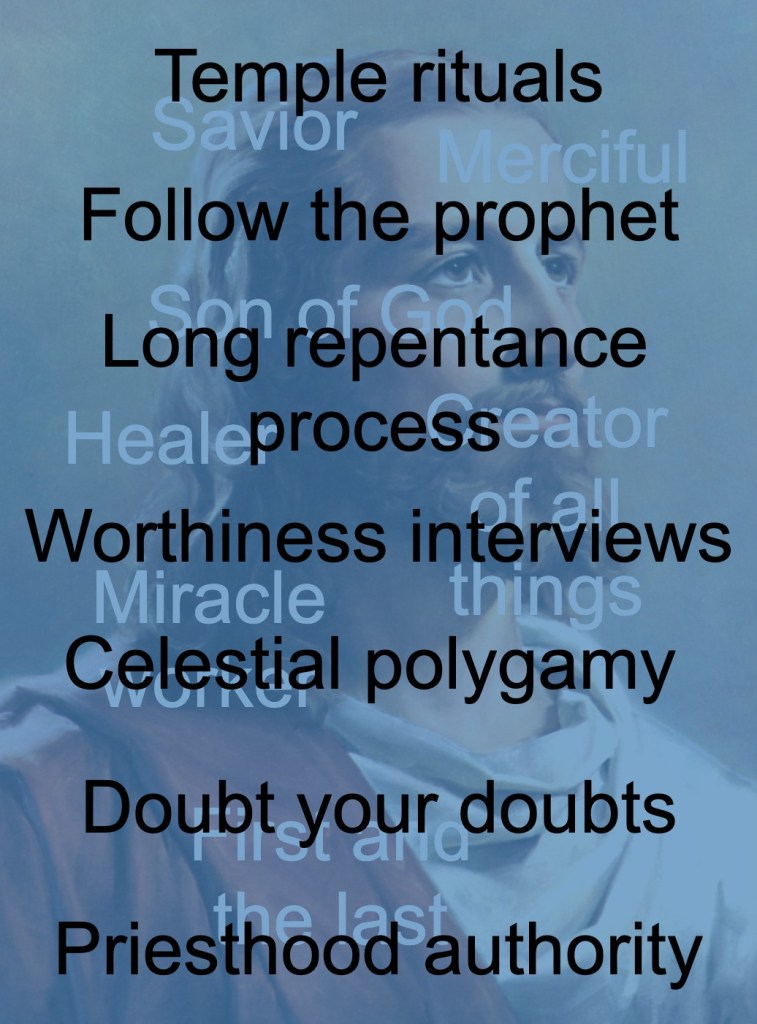

Too many Mormons center their faith on unique LDS doctrines such as temples, prophets and priesthood, but for many others these are just supplemental aspects of their faith. Many Mormons do focus their faith on Jesus of Nazareth, the son of Mary, baptized by John the Baptist, the healer and miracle worker who died on the cross and rose again three days later. The Jesus who taught that the most important commandment is to love God and love one another. As a member of the LDS church for the first 28 years of my life, I LOVED this Jesus. And since I was devoted to Jesus I was also devoted to what I was told was “His church.” I didn’t believe in a different Jesus, but I only knew the parts of Him that fit within the LDS box. It was my pre-existing trust in Jesus that allowed Him to show me the errors in my religion and show me His simple gospel of grace.
I’d compare Mormon’s understanding of Jesus to a child’s understanding of their grandparents. We as adults have had a lifetime with our parents, we know their personality traits, their greatest joys and pains, we have a variety of memories with them. Our children on the other hand have only a fundamental understanding of who their grandparents are. They know they are our parents, they know they love them, they have (hopefully) a few years worth of memories with them, but they don’t know them as intimately as we do. At a young age our kids can’t comprehend the full spectrum of their grandparents’ personalities, life experience, skills, emotions, etc. This does not mean that they “don’t know the same grandparent,” it means they have a very elementary understanding of who they are and have much more to learn.
This is how we must see Mormons, people who have read of Jesus in parts of the New Testament and believe they’re part of His church, but who have a very elementary understanding of who He really is. For so many Mormons, their intentions are right, their hearts love Jesus and they obey God in the way they have been told He wants them to obey. But their intention toward God misses the mark because of the deceptive lens they have over their eyes. It’s a good thing that God looks upon our hearts (1 Samuel 16:7) and not a checklist of correct theology.
Woe to You, Scribes and Pharisees
Of course we must use discernment because there are certainly different types of Mormons. Not all have the intentions of just loving Jesus. You’ve likely encountered the arrogant Mormon apologists in social media arguments, the ones who will defend the church against any criticism and get really ugly doing it. The ones who are complete jerks in the name of the Lord. These people are more focused on being members of “the one true church” than they are are about following the teachings of Jesus.
It’s a religious spirit that breeds pride, self-righteousness, arrogance and assurance in their works-based gospel. Like the Pharisees, nothing you could argue will change their minds because according to their heavily ingrained religious system, they are RIGHT. For this reason it’s futile to argue with people with a religious spirit. The best we can do is pray for them, pray against the religious spirit and pray that Jesus encounters them. Pray that they God removes the scales from their eyes to see the deception they are living in.
Now it’s crucial that we differentiate the deceived from the deceivers, just as Jesus did. The past and current leaders of the LDS church, the ones who developed, manipulated and perpetuated the LDS gospel, are the deceivers, the modern day scribes, Pharisees and Chief Priests. We know how Jesus spoke of men in these positions, calling them hypocrites (Matthew 23:13-15), blind guides (Matthew 23:16), a den of vipers (Matthew 23:33), wolves in sheep’s clothing (Matthew 7:15), even children of the devil (John 8:44). When Jesus spoke to these religious leaders, the false teachers teaching their false traditions (Mark 7:7-9), he spoke with condemnation and criticism. But that’s not how He spoke to those they deceived.

Jesus spoke with condemnation towards the scribes, Pharisees and Chief Priests, but He did not speak to all Jews this way. Below the Jewish leadership and upper class were millions of lowly Jews, born into a faulty system. They had been taught some truths about looking forward to the coming Messiah but had also been deceived by false traditions and the Pharisees’ false interpretations of who the Messiah would be. They believed the Messiah would save them, although the religion’s false teachings clouded their understanding of what “saved” meant, as they anticipated a great political ruler to save them from the Roman empire. Jesus condemned the deceivers in leadership, but when He spoke to common Jews he was compassionate, merciful and patient. He didn’t condemn them for not already understanding exactly who He was, he met them where they were at and showed them who He truly was. For thousands, that imperfect faith in the Messiah was enough for them to recognize Him!
There were even some Pharisees that had open hearts and minds towards Jesus. When Nicodemus came to Jesus with genuine questions Jesus responded respectfully and testified of truth. Jesus didn’t condemn Nicodemus just because he was a Pharisee, he saw his heart and his faith and spoke to that. Jesus didn’t make blanket judgements about all people of a certain group, he discerned the intention of every individual he spoke to, as should we.
You’ll notice that I even included missionaries on the deceived side of the scale. Just as hurt people hurt people, deceived people deceive people. Please give these young people grace and recognize their good intentions to serve God. Most missionaries have just graduated high school and left their parent’s homes for the first time with no other real-world experience. These kids are out doing what they’ve been told God wants them to do, eager to please God. (Others are there against their will). Please know that a badge on their shirt is not their end-game. God sees past that uniform and has sometimes even reached LDS missionaries while on their missions. There are some incredible stories of LDS missionaries coming to know the real gospel of grace while on their missions with the help of a kind and patient Christian friend.
Jesus condemned the deceivers but was gracious to the deceived. Aside from the deceiving leaders and arrogant members, there are humble, righteous Mormons who love Jesus Christ and are doing their best to follow him with the information that they have been given. These Mormons are on the right track but still have more to learn about the amazing grace of God. Isn’t this true for all of us?
Jesus Didn’t Teach Us To Be Divisive
I frequently hear Christians use the phrase “the truth is divisive” as an excuse to act contentiously. Christians often tell Mormons that they aren’t Christians… as if that’s what Jesus would do? Well yeah, Jesus said “not all those who say Lord Lord will enter the kingdom of heaven!” (Matthew 7:15-23). Yes I’m sure someone could dig up some social media comment were I also said this, however I’ve been convicted to change my thinking. When we read this verse within the context of the passage, we see that once again, Jesus was only using this condemning language towards the false teachers, not the common folk doing their best with their limited understanding.
Before Jesus left the earth he prayed for his disciples, in his prayer he declared that their message of truth would be sanctifying and unifying.
John 17:17-20
17 Sanctify them by the truth; Your word is truth.
18 As You sent Me into the world, I have also sent them into the world.
19 For them I sanctify Myself, so that they too may be sanctified by the truth.
20 I am not asking on behalf of them alone, but also on behalf of those who will believe in Me through their message,
21 That all of them may be one, as You, Father, are in Me, and I am in You.
The truth sanctifies and unifies! The truth of Jesus brings us closer together as we love and testify to each other. Jesus never told us to condemn others with lesser testimonies or imperfect understandings of his gospel, he taught us to encourage each other on our unique walks with God. Some of us have testimonies of God’s power healing a marriage, being saved from addiction, or His miraculous provision. When shared in love, focusing on Jesus, our testimonies of His truth sanctifies and unifies people.
Jesus never told us to be divisive, although many like to claim he did in Luke 12. The thing about division is that in order to divide something, it must first be unified. In his passage Jesus was describing the natural division that occurs in families when one or two individuals accept His truth while other family members choose to remain in their false traditions.
Luke 12:51-53
51 Do you suppose that I came to give peace on earth? I tell you, not at all, but rather division.
52 For from now on five in one house will be divided: three against two, and two against three.
53 Father will be divided against son and son against father, mother against daughter and daughter against mother, mother-in-law against her daughter-in-law and daughter-in-law against her mother-in-law.
Even though Jesus taught mercy, forgiveness, peacefulness and love, the overwhelming response to his message was not peaceful. Those who rejected Jesus’s truth rejected and persecuted those who embraced it. A family unified by false religion is divided by truth, two already opposing religions were never unified to begin with.
People who grew up in Mormon families and left the faith know this rejection all too well. Many who learn the truth about the LDS church suddenly find themselves divided against their father, mother, siblings or children. Accusations of sin and deception are shot at the individual who had the courage to say the LDS church is not what they believed it was. These individuals not only suffer a faith crisis but often an identity crisis as well. This life crisis grows in layers of depression, anxiety, anger, and grief, dimming the joy of newfound freedom.
Before a Mormon makes the final decision to leave the church there are usually months or years of fence sitting, researching and weighing the options. Even if their family is loving and not judgmental, their relationships are never the same. Don’t talk to unsure Mormons as if they’re idiots who have nothing to loose by just accepting the truth and breaking ties with the LDS church. These people have everything to lose. Countless marriages have ended because one spouse left the church and the other stayed. Masses of children have been estranged or disowned by their parents and grandparents. Choosing to question the LDS church is choosing to initiate a life-altering identity crisis. When this happens, they need a safe place to land to discover the true goodness of God and their identity in Him.
Please keep in mind, that only about 20% of people who leave the Mormon church maintain a faith in God, the vast majority lose their faith all together. An all-loving, merciful, gracious God is pretty hard to fathom after realizing you’ve been deceived by a false religion your entire life. This good God is even harder to believe in when his supposed Christian followers are not loving, merciful or gracious either. You can’t be contentious to Mormons then wonder why they don’t want to join you for Sunday service once they start questioning their faith.
Jesus Draws People to Himself
It’s important to know that Jesus draws all people to himself (John 12:32). The work is His and our role is to simply love others on their journeys. Since Covid, people have been leaving the LDS church in droves. At this very moment, thousands of Mormons are on silent personal journeys seeking truth. God answers every sincere prayer and the Holy Spirit likely has already started to reveal bits of truth to these people. Deconstructing one’s entire religious worldview does not happen over night, this can be a long process. God meets them where they are at and is patiently waiting to answer each one of their questions as it comes up, we can be patient too.
Let’s not forget that no seasoned Christian started out with a perfect understanding of Jesus and his gospel of grace. I’ve heard too many stories of people all over the spectrum of Christianity who were raised with a basic faith in God but were taught a variety of false traditions and harmful dogma. From women not being allowed to preach to false prophets promising healing in exchange for hefty donations, the devil works his deception into various corners of Christianity.
The message of Jesus is often overpowered by the preaching of fire and brimstone, guilt and shame, leading Christians to grow up with some level of fear of disappointing an angry, vengeful God. Most people who grow up in a mainstream Christian church didn’t have a personal transformative experience with Jesus until later in life, and that spiritual transformation didn’t come from religious people telling them how wrong they were.

Every conversation Christians have with Mormons about religious differences plants a seed. Contentious and divisive conversations plant bad seeds, and the more fuel they are given the more likely they are to pluck the weed and give up on Christianity all together. Let’s resolve to only plant good seeds, as we focus our conversations on the goodness of God and demonstrate the fruits of the spirit. Then the nurturing of the Holy Spirit can grow roots of unity into their soil and sanctify them on their long difficult journey out of false religion.
Though I’ve written several articles on the falsehoods of LDS doctrines, there is something even more effective than just throwing Bible verses at them: sharing our own personal testimonies of God’s redeeming, healing, saving power outside the limits of their religious construct. Christianity isn’t about believing in the right set of doctrines, its about being fully transformed by Jesus. Instead of just telling Mormons they’re not saved by Jesus we need to testify of how Jesus has saved us! Jesus told his disciples that people “will know them by their fruits.” We can do this in two ways in our conversations with Mormons.
- Demonstrate the fruits of the spirit: gentleness, peace and patience while seeking to understand their personal faith in Jesus. Ask them about their testimony of Jesus, what has He done in their lives? If they start to say “the temple is.. this priesthood blessing.. etc,” kindly rephrase the question again. “The temple and priesthood blessing sound special to you, but what about your relationship with Jesus?”
- Share with them the miracles Jesus has done in your life and what it feels like to be redeemed by His grace. I can say that although I loved Jesus while in Mormonism I did not experience the fullness of His power until leaving. Through the years of depression, anxiety, and a marriage that nearly ended post Mormonism, Jesus showed up and saved us. Anxiety disappeared at the mention of Jesus’s name. He healed our depression, dissociation and other mental health struggles. And in the moment we were throwing in the towel giving up on each other, He stepped in and fully redeemed and transformed our marriage into something more beautiful than we had ever imagined.
Let us be bold in sharing our testimonies of how Jesus saved us and transformed us. Let’s keep the conversation rightfully centered on His goodness, full of patience and grace. The last thing we want to do is create defensiveness with inflammatory phrases like “you’re not Christian.” Defensiveness kills openness and curiosity, it pushes them farther from the truth. To prevent defensiveness we need to find common ground and help them find their sure foundation in Jesus before the false religion comes crashing down.
Samaritans and Mormons
Consider Jesus’s conversation with the woman at the well in John 4. When the woman was approached by Jesus she naturally put her guards up, anticipating contention between this Jewish man, and herself a Samaritan woman. The Jews viewed Samaritans as apostates who had corrupted their religion through centuries of intermarrying with Assyrians and adopting their pagan traditions… An outcast group deceived by generations of mixing Abrahamic tradition with pagan idolatry? That sounds a lot like Christians’ problems with Mormons.
Centuries after intermarrying with the Assyrians, the Samaritans slowly shed most of their pagan traditions and refocused on solely worshipping the God of Abraham. Though they had refocused their faith, the Jews contempt with Samaria continued. The Samaritans returned to Abrahamic tradition but with their own version of the Torah and still maintaining that their Mount Gerizim was to be the alter hearth as opposed to Jerusalem’s temple. So though the Samaritans had conformed back to mostly Jewish worship, there were still some major rifts between the two factions. And some historians even suggest evidence that during the Hellenistic period (under the Roman Empire) some small Samaritan groups did welcome Hellenistic worship, possibly proving to the Jews their susceptibility to embracing paganism.

9 Then the woman of Samaria said to Him, “How is it that you, being a Jew, ask a drink from me, a Samaritan woman?” For Jews have no dealings with Samaritans.
The Samaritan woman is rightfully on guard, although Jews and Samaritans both worship the God of Israel, the Samaritan is rejected because of the false traditions of her ancestors. Jesus disregards her defensive attitude and comments on the goodness of God and the living water He could provide. After prophesying about her life she perceives that he was a prophet and again probes him about why the Samaritans were seen as less-than for worshiping on the mountain their father Jacob worshiped on rather than in Jerusalem’s temple. Now if Jesus was a contentious petty Christian like us, perhaps he would have said something like “well you’re not a true Israelite anyway, you have your own version of the Torah? You worship on the mountain because your fathers did? That’s all wrong! You believe in the wrong Messiah anyway, he’s not going to save you from Rome.” …But he didn’t do that.
21 Jesus said to her, “Woman, believe Me, the hour is coming when you will neither on this mountain, nor in Jerusalem, worship the Father.
22 You worship what you do not know; we know what we worship, for salvation is of the Jews.
23 But the hour is coming, and now is, when the true worshipers will worship the Father in spirit and truth; for the Father is seeking such to worship Him.
24 God is Spirit, and those who worship Him must worship in spirit and truth.”
Not only did Jesus not condemn her for her religious differences, but he found commonality by saying that both temple and mountain worship were imperfect systems and God wanted something much more simple and genuine. Jesus focused on the goodness of God and how He is seeking people to worship him in spirit and truth. Jesus separated her deception from her intention. Though her natal religion was laced with generational deception, her heart posture was full of good intention to do God’s will. Jesus dismantled her defensiveness by focusing on common ground and the goodness of God. The woman recognized his words as truth and then shared her faith that the Messiah would clarify everything.
25 The woman said to Him, “I know that Messiah is coming” (who is called Christ). “When He comes, He will tell us all things.”
Even though this Samaritan woman came from deception, correction and rejection, her soul longed for truth and she held on to her faith that the Messiah would make all things right. Jesus saw that. He knew her heart and he knows Mormon’s hearts. And in that moment of vulnerability, Jesus revealed himself to her.
26 Jesus said to her, “I who speak to you am He.”
Jesus didn’t break her down before lifting her up. He didn’t pick apart every aspect of her religion. He didn’t condemn her for her imperfect faith in the Messiah. He saw her heart, her intention, and he met her there. Jesus is patient with us as the Holy Spirit plants questions that pull us out of the deception we were born into. We must be patient and long-suffering with Mormons while they are yet in the deception if we want them to unite with us as they come out of it.
Conversations Full of Grace
The Bible is full of great advice on how to have conversations sharing truth and handling disagreement. We must stop saying these careless words that Mormons they aren’t Christians and that they believe in a different Jesus. It completely discredits the work Jesus has already done, is doing and is yet to do in their lives. These statements cause instant defensiveness, but finding common ground kills defensiveness. Here are a few passages we should meditate on to allow the Holy Spirit to fill us with patience and grace towards our LDS friends. Let us learn to meet them where they are at and give them the grace they need to grow.
Ephesians 4:29
“Let no corrupting talk come out of your mouth, but only such as is good for building up as fits the occasion that it may give grace to those who here we need to only speak in a way that builds up the person we are talking to and gives them grace let all bitterness and wrath and anger and clamor and slander they put away from you along with all malice, be kind to one another tender hearted, forgiving one another as God in Christ for forgive you.”
Whatever comes out of our mouths should build up the person we are talking to, our words must be gracious to them. Not only does this create a relationship of trust but it allows the Holy Spirit to do its work inside of them. Our divisive words will never change anyones minds, only the Holy Spirit can do that, so its our job to embody the fruits of the Spirit: love, patience, kindness, gentleness, peace, self-control. Plant good seeds by asking about their testimony of Jesus and sharing yours.
Colossians 4:5-6
“Walk in wisdom toward those who are outside, redeeming the time. Let your speech always be with grace, seasoned with salt, that you may know how you ought to answer each one.”
Please pray for wisdom and discernment when talking to those you consider outsiders. Remember good-hearted Mormons are the deceived not the deceivers. Jesus was very wise and merciful to the deceived, always giving them grace for being raised in false traditions. If we as Christians are going to testify of the Most High God, the merciful Jesus Christ, the God of Love, we’d better do it in a loving and gracious way.
Matthew 12:36-37
“On the day of judgment people will give account for every careless word they speak. For by your words you will be justified and by your words you will be condemned.
If we do not speak to these people with grace, love and compassion for where they are at, we will be judged for the careless and inaccurate way that we represent Jesus. We can’t act like we know Jesus better but treat people in an un-Christlike manner, this is self-righteous hypocrisy.
Proverbs 15:1, 4
“A soft answer turns away wrath, but a harsh word stirs up anger… A gentle tongue is a tree of life, but perverseness, and it breaks the spirit.”
We do not want to break the spirits of these Mormon friends. We want to help remove that false lens they are seeing through to more clearly reveal the Jesus they already love. Surely we can grow our emotional and spiritual maturity to hold our tongues and learn to only speak in a tactful and fruitful manner. Don’t condemn them for not knowing the “real Jesus,” instead simply show them who the real Jesus is by your patience and love. When we focus on how good Jesus is instead of how wrong they are, it creates a loving atmosphere for them to confidently keep asking questions. We want them to feel that they’re welcome at our table, not that they can’t sit with us unless they conform.
I want to end with a huge thank you to our Christian friends who let us sit at their tables while we were Mormon and loved us just the same after we left. Despite even giving them a Book of Mormon, these friends saw our hearts and loved us, sharing dinners, vacations, and spiritual conversations over the years of friendship. We never received any judgement from them about our beliefs. When friends and family cast us away, they caught us and told us they were proud of us. Some even drove 4 hours to visit us for a few days in the midst of losing our community. Every Mormon who leaves the church needs friends like these.
Ex-Mormon Christian Testimonials
“Nothing will make a Mormon stop listening to a person faster than being told they aren’t Christian. It is a hurtful, divisive statement. As a devout Mormon for 37 years, I learned to LOVE Jesus. I loved Him so much and I prayed to Him and received help many, many times. I knew Him as a Healer and as a Comforter. The problem is more of a cloudy view with false doctrines in the way.
Recently as I was sitting in the beautiful Christian church the Lord led me to attend, I heard Him say “unveiled” and He showed me a bride with a veil. The bride could not see well through her veil. In this vision, the groom then lifted up her veil over her face as is tradition at weddings and the full splendor of the groom was then revealed. Right now this is what the Lord is doing among the LDS faith tradition. He is unveiling Himself to many in a big way! I am so grateful He unveiled Himself to me, for I now know Him as my Savior and Redeemer.”
– Krystle O.
“It doesn’t help to approach a Latter Day Saint and say they aren’t Christian or that they believe in a different Jesus. I do think it is correct to say that the LDS Church preaches a different Jesus—not only do they teach hugely incorrect things about Him and His doctrine, but they attribute many words and revelations to Him that He did not speak. It’s a made-up Jesus based on the biblical Jesus. BUT, I do think many Latter Day Saints believe in the real Jesus because they read the gospels and learn about Him there.
I remember as a Latter Day Saint, I cherished the Bible stories about Jesus. That’s where I really got to know who Jesus was. I didn’t much like reading the Doctrine and Covenants, and even though I focused my time on the Book of Mormon, the Jesus in that book didn’t really resonate with me—like it never sunk in that that was who Jesus was. It just felt different than Jesus in the gospels. So whenever I thought about Jesus, I often thought of Him in the gospels—the real Jesus. But, the false things I was taught about Him in the church made Him feel distant to me. It made it harder for me to connect to Him. I loved Him, but I didn’t know Him nearly as well as I could have. I had a good relationship with the Father, but felt like I had almost no relationship with Jesus. Choosing to read the Bible cover to cover changed everything for me. I finally got to know who Jesus really was. So I’d say I believed in the Biblical Jesus, but I believed many incorrect things about Him which hampered my relationship with Him.
But before learning the truth about who Jesus was and converting to Him for real, I would have balked if anyone said I didn’t believe in the real Jesus—I’d be like, Hello! We believe in the Jesus of the Bible! That’s the SAME Jesus! And if someone said I wasn’t Christian, I’d be like, I’m pretty sure I’m more Christian than you because I believe in not just one, but THREE books of scripture with His words in it. So you’re absolutely right, saying these things does NOT work, not at all.
I’m still working out what the best approach is to share the gospel with Latter Day Saints, but I do know that we have to be sensitive. We need to show respect—recognize that LDS are not dumb, they have their reasons for believing the way they do, they study the scriptures and many are deep thinkers! We need to listen to them and let them share what they believe—never assume what anyone in the LDS Church believes because there is so much variance! We need to be patient—LDS have a very hard time accepting the Biblical gospel because they are deeply entrenched in their own doctrines and interpretations. We need to recognize that most Latter Day Saints have a real relationship with God. And we need to be loving—instead of attacking what they cherish, lovingly share biblical truth—God’s own words are powerful. We don’t have to point out everything that’s wrong with their church. I think we mostly need to help them understand who Jesus really is and what He did for us, and why we need to accept His work in faith. If we can accomplish that, we’ve laid the groundwork for them to be saved, and they may figure out the rest on their own, or become open to hearing more. And I think it would help a lot to show them how the Bible is reliable—distrust in the Bible is a huge stumbling block.”
– Lisa T.
 Ex-Mormon Bible Study
Leave a comment