
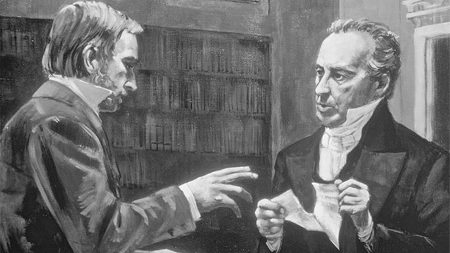
The vision of all is become unto you as the words of a book that is sealed, which men deliver to one that is learned, saying, “Read this, I pray thee,” and he saith, “I cannot; for it is sealed.” And the book is delivered to him that is not learned, saying, “Read this, I pray thee,” and he saith, “I am not learned.”
Isaiah 29:11-12
The story of Martin Harris taking Book of Mormon characters to a “learned man” is told in the LDS tradition as a fulfilment of prophecy and evidence of the inspired Book of Mormon translation. While Martin Harris did take some written characters to Professor Charles Anthon some time before 1829, the details of that event have been inconsistently and deceitfully portrayed. Here we’ll examine the two quotes from Joseph Smith on this event, one from 1832 when Martin Harris was still in the church, and the other from 1838 after he had been excommunicated. We will then consider other witnesses and finally, compare the assertions of fulfilling prophecy with the scriptural prophecies.
In the early years of the church, Joseph Smith recounted this event of Martin speaking with the professor as a key detail in the restoration story and recorded it in both the 1832 and 1838 Church Histories.
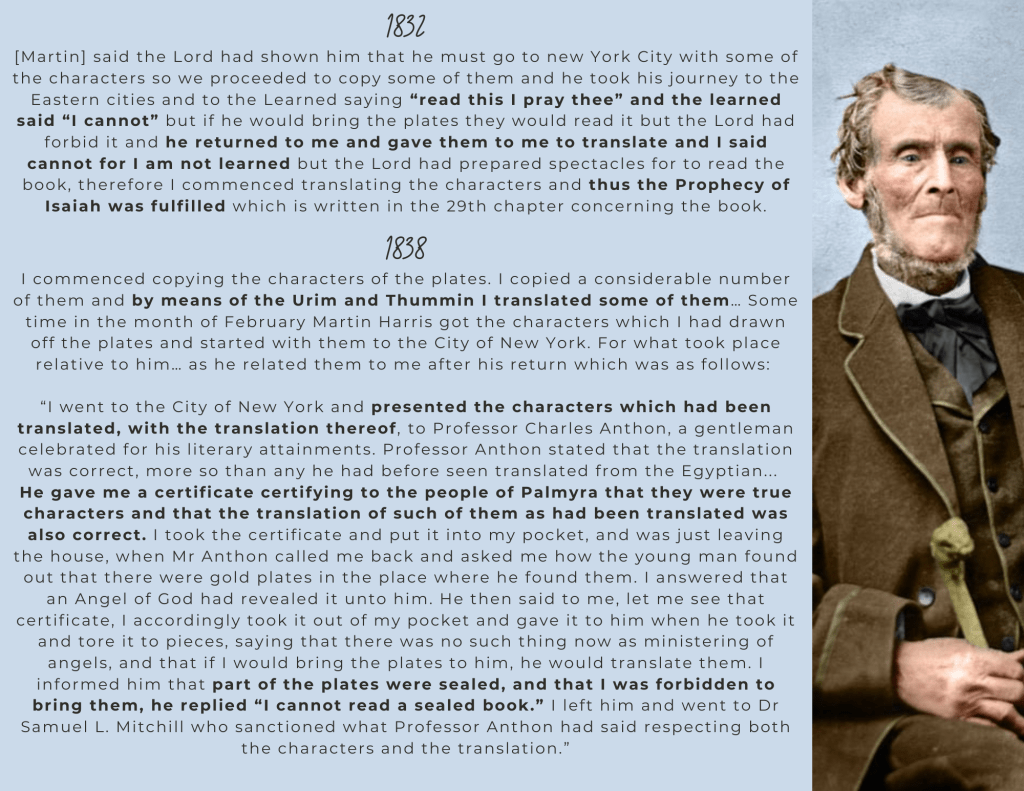
Let’s compare the details of this story recorded in the 1832 version compared to the 1838 version.
1832
- Joseph copies characters from the golden plates for Harris to show Professor Anthon.
- When asked to read the characters Anthon says “I cannot.”
- Harris returns to Smith and tells him that he would have to translated them, to which Smith replied “I cannot for I am not learned.”
- Joseph learns after the meeting with the professor that the Lord prepared the spectacles (Urim & Thummim) to translate the plates.
1838
- Joseph copies characters from the golden plates and uses the Urim & Thummim to translate some of them.
- Harris brings Professor Anthon the copied characters and their translations.
- Professor Anthon is able to read the characters and gave Harris a certificate verifying that the characters were true and their translation was correct.
- Anthon asks to see the plates himself but Harris tells him the plates were sealed, to which Anthon replies “I cannot read a sealed book.”
Critical Thinking Questions
When we read these two accounts side by side its evident they can’t both be true. Did Joseph doubt his ability to translate the plates when he had already done so? Did Professor Anthon read the characters or not? If he did read them, can this story really fulfill Isaiah 29?
- Why would Joseph say he was too “unlearned” to translate the plates when he had already been translating for over a year? He began translating with Emma as his scribe in 1827 then with Martin in 1828.
- The first account states that Professor Anthon was not able to read the copied characters. The second account states that the professor did read the characters and gave a certificate verifying their translation. How can these completely contradictory stories both be true?
- If Professor Anthon gave Martin a certificate of authenticity, why wasn’t this critical information included in the 1832 account? Why was it only mentioned in 1838, after Martin had been excommunicated & couldn’t verify the story?
- If after the meeting with Anthon, Martin then went to Dr Samuel Mitchill who verified both the characters and translations, why was there no certificate or mention of this earlier either?
- Did Professor Anthon give an account of his side of the story? What would he say happened?
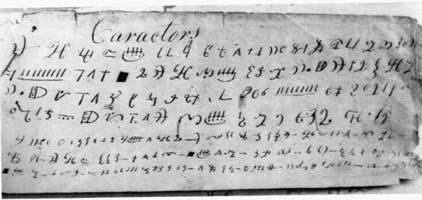
Professor Anthon’s Side of the Story
There are three known letters written by Professor Charles Anthon sharing his perspective of his interaction with Martin Harris. Anthon goes into great detail recalling the interaction with only minor discrepancies between accounts (mainly in the first account stating he did not give a written certificate, but in the later accounts remembering had given a written warning that the characters were a hoax). Despite this one variance, Anthon’s descriptions show a great consistent memory of the conversations had with Martin Harris, the simple farmer whom he had forgotten the name of. All three letters, written in 1834, 1841 (published in this 1842 book) and 1843 can be read in full here, or you can click on each arrow below to expand and read.
1834 Letter “The whole story about my having pronounced the Mormonite inscription to be ‘reformed Egyptian hieroglyphics’ is perfectly false.”
Dear Sir — I received this morning your favor of the 9th instant, and lose no time in making a reply. The whole story about my having pronounced the Mormonite inscription to be “reformed Egyptian hieroglyphics” is perfectly false. Some years ago, a plain, and apparently simple-hearted farmer, called upon me with a note from Dr. Mitchell of our city, now deceased, requesting me to decipher, if possible, a paper, which the farmer would hand me, and which Dr. M. confessed he had been unable to understand. Upon examining the paper in question, I soon came to the conclusion that it was all a trick, perhaps a hoax. When I asked the person, who brought it, how he obtained the writing, he gave me, as far as I can now recollect, the following account:
A “gold book,” consisting of a number of plates of gold, fastened together in the shape of a book by wires of the same metal, had been dug up in the northern part of the state of New York, and along with the book an enormous pair of “gold spectacles”! These spectacles were so large, that, if a person attempted to look through them, his two eyes would have to be turned towards one of the glasses merely, the spectacles in question being altogether too large for the breadth of the human face. Whoever examined the plates through the spectacles, was enabled not only to read them, but fully to understand their meaning. All this knowledge, however, was confined at that time to a young man, who had the trunk containing the book and spectacles in his sole possession. This young man was placed behind a curtain, in the garret of a farm house, and, being thus concealed from view, put on the spectacles occasionally, or rather, looked through one of the glasses, deciphered the characters in the book, and, having committed some of them to paper, handed copies from behind the curtain, to those who stood on the outside.
Not a word, however, was said about the plates having been deciphered “by the gift of God.” Every thing, in this way, was effected by the large pair of spectacles. The farmer added, that he had been requested to contribute a sum of money towards the publication of the “golden book,” the contents of which would, as he had been assured, produce an entire change in the world and save it from ruin. So urgent had been these solicitations, that he intended selling his farm and handing over the amount received to those who wished to publish the plates. As a last precautionary step, however, he had resolved to come to New York, and obtain the opinion of the learned about the meaning of the paper which he brought with him, and which had been given him as a part of the contents of the book, although no translation had been furnished at the time by the young man with the spectacles.
On hearing this odd story, I changed my opinion about the paper, and, instead of viewing it any longer as a hoax upon the learned, I began to regard it as part of a scheme to cheat the farmer of his money, and I communicated my suspicions to him, warning him to beware of rogues.
He requested an opinion from me in writing, which of course I declined giving, and he then took his leave carrying the paper with him. This paper was in fact a singular scrawl. It consisted of all kinds of crooked characters disposed in columns, and had evidently been prepared by some person who had before him at the time a book containing various alphabets. Greek and Hebrew letters, crosses and flourishes, Roman letters inverted or placed sideways, who arranged in perpendicular columns, and the whole ended in a rude delineation of a circle divided into various compartments, decked with various strange marks, and evidently copied after the Mexican Calender given by Humboldt, but copied in such a way as not to betray the source whence it was derived.
I am thus particular as to the contents of the paper, inasmuch as I have frequently conversed with my friends on the subject, since the Mormonite excitement began, and well remember that the paper contained any thing else but “Egyptian Hieroglyphics.”
Some time after, the same farmer paid me a second visit. He brought with him the golden book in print, and offered it to me for sale. I declined purchasing. He then asked permission to leave the book with me for examination. I declined receiving it, although his manner was strangely urgent.
I adverted once more to the roguery which had been in my opinion practiced upon him, and asked him what had become of the gold plates. He informed me that they were in a trunk with the large pair of spectacles. I advised him to go to a magistrate and have the trunk examined. He said the “curse of God” would come upon him should he do this. On my pressing him, however, to pursue the course which I had recommended, he told me that he would open the trunk, if I would take the “curse of God” upon myself. I replied that I would do so with the greatest willingness, and would incur every risk of that nature, provided I could only extricate him from the grasp of rogues. He then left me. I have thus given you a full statement of all that I know respecting the origin of Mormonism, and must beg you, as a personal favor, to publish this letter immediately, should you find my name mentioned again by these wretched fanatics.
1841 Letter “A very brief examination of the paper convinced me that it was a mere hoax, and a very clumsy one too.”
Rev. and Dear Sir – Many years ago, the precise date I do not now recollect, a plain looking countryman called upon me with a letter from Dr. Samuel L. Mitchell requesting me to examine, and give my opinion upon, a certain paper, marked with various characters which the Doctor confessed he could not decipher, and which the bearer of the note was very anxious to have explained. A very brief examination of the paper convinced me that it was a mere hoax, and a very clumsy one too.
The characters were arranged in columns, like the Chinese mode of writing, and presented the most singular medley that I ever beheld. Greek, Hebrew, and all sorts of letters, more or less distorted, either through unskillfulness, or from actual design, were intermingled with sundry delineations of half moons, stars, and other natural objects, and the whole ended in a rude representation of the Mexican zodiac. The conclusion was irresistible, that some cunning fellow had prepared the paper in question, for the purpose of imposing upon the countryman who brought it, and I told the man so without any hesitation. He then proceeded to give me a history of the whole affair, which convinced me that he had fallen into the hands of some sharper, while is left me in great astonishment at his own simplicity.
The countryman old me that a gold book had been recently dug up in the wester or northern part (l forget which), of our state, and he described this book as consisting of many gold plates, like leaves, secured by a gold wire passing through the age of each, just as the leaves of a book are sewed together, and presented in this way the appearance of a volume. Each plate, according to him, was inscribed with unknown characters, and the paper which he handed me, a transcript of one of these pages.
On my asking him by whom the copy was made, he gravely stated, what along with the golden book there had been dug op a very large pair of spectacles! So large in fact that if a man were to hold them in front of his face, his two eyes would merely look through one of the glasses, and the remaining part of the spectacles would project a considerable distance sideways! These spectacles possessed, it seems a very valuable property, of enabling any one who looked through them, for rather through one of the lenses,) not only to decipher the characters on the plates, but also l comprehend their exact meaning, and be able to translate them!! My informant assured me that this curious property of the spectacles had been actually tested, and found to be true.
A young man, it seems, had been placed in the garret of a farmhouse, with a curtain before him, and having fastened the spectacles to his head, had read several pages in the golden book, and communicated their contents in writing to certain persons stationed on the outside of the curtain. He had also copied off one page of the book in the original character, which he had in like manner handed over to those who were separated from him by the curtain, and this copy was the paper which the countryman had brought with him. As the golden book was said to contain very great truths, and most important revelations of a religious nature, a strong desire had been expressed by several persons in the countryman’s neighborhood, to have the whole work translated and published. A proposition had accordingly been made to my informant, to sell his farm, and apply the proceeds the printing of the golden book, and the golden plates were to be left with him as security until he should be reimbursed by the sale of the work. To convince him more clearly that there was no risk whatever in the matter, and that the work was actually what it claimed to be, he was told to take the paper, which purported to be a copy of one of the pages of the book, to the city of New York, and submit it to the learned in that quarter, who would soon dispel all his doubts, and satisfy him as to the perfect safety of the investment.
As Dr. Mitchell was our “Magnus Apollo” in those days, the man called first upon him; but the Doctor, evidently suspecting some trick, declined giving any opinion about the matter, and sent the countryman down to the college, to see, in all probability, what the “learned pundits” in that place would make of the affair. On my telling the bearer of the paper that an attempt had been made to impose on him, and defraud him of his property, he requested me to give him my opinion in writing about the paper which he had shown to me. I did so without any hesitation, partly for the man’s sake, and partly to let the individual “behind the curtain” see that his trick was discovered. The import of what I wrote was, as far as I can now recollect, simply this, that the marks in the paper appeared to be merely an imitation of various alphabetical characters, and had, in my opinion, no meaning at all connected with them. The countryman then took his leave, with many thanks, and with the express declaration that he would in no shape part with his farm or embark in the speculation of printing the golden book.
The matter rested here for a considerable time, until one day, when I had ceased entirely to think of the countryman and his paper, this same individual, to my great surprise, paid me a second visit. He now brought with him a duodecimo volume, which he said was a translation into English of the ” Golden Bible.” He also stated, that notwithstanding his original determination not to sell his farm, he had been induced eventually to do so, and apply the money to the publication of the book, and had received the golden plates as a security for repay. ment. He begged my acceptance of the volume, assuring me that it would be found extremely interesting, and that it was already ” making a great noise” in the upper part of the state. Suspecting now that some serious trick was on foot, and that my plain looking visitor might be in fact a very cunning fellow I declined his present. and merely contented myself with a slight examination of the volume while he stood by. The more I declined receiving it however, the more urgent the man became in offering the book, until at last I told him plainly, that if he left the volume, as he said he intended to do, I should most assuredly throw it after him as he departed.
I then asked him how he could be so foolish as to sell his farm and engage in this affair; and requested him to tell me if the plates were really of gold. In answer to this latter inquiry, he said that he had never seen the plates themselves, which were carefully locked up in a trunk, but that he had the trunk in his possession. I advised him by all means to open the trunk and examine the contents, and if the plates proved to be of gold, which I did not believe at all, to sell them immediately. His reply was, that if he opened the trunk the “curse of heaven would descend upon him and his children.” “However,” added he “I will agree to open it, provided you will take the ‘curse of Heaven’ upon yourself for having advised me to the step.” I told him I was perfectly willing to do so, and begged he would hasten home and examine the trunk, for he would find he had been cheated. He promised to do as I recommended, and left me, taking his book with him. I have never seen him since.
Such is a plain statement of all that I know respecting the Mormons. My impression now is, that the plain looking countryman was none other than the prophet Smith himself, who assumed an appearance of great simplicity in order to entrap me, if possible, into some recommendation of his book. That the prophet aided me by his inspiration, in interpreting the volume, is only one of the many amusing falsehoods which the Mormonites utter relative to my participation in their doctrines. Of these doctrines I know nothing whatever, nor have I ever heard a single discourse from any one of their preachers, although I have often felt a strong curiosity to become an auditor, since my friends tell me that they frequently name me in their sermons, and even go so far as to say that I am alluded to in the prophecies of Scripture!
If what I have here written shall prove of any service in opening the eyes of some of their deluded followers to the real designs of those who profess to be the apostles of Mormonism, it will afford me a satisfaction, equalled, I have no doubt only by that which you yourself will feel on this subject.
1843 Letter “I told the man at once that he was imposed upon & that the writing was mere trash.”
Rev. and Dear Sir – The Mormon story is a complete falsehood. A person called upon me many years ago & showed me a pretended transcript of a page of the Golden Bible, desiring me at the same time to favor him with a translation. It required but a single glance to perceive that the whole affair was a sheer and very clumsy imposition. The paper contained in one or two parallel columns rude imitations of Hebrew & Greek characters together with various delineations of sun, moon, stars, etc. The man who handed me the scrawl had previously taken it to Dr. Mitchell and had been referred by that gentleman to me. He stated that he was about to engage in the affair of the Golden Book & (if my memory serve me right) intended to sell his farm & appropriate the proceeds to the publication of the volume.
I told him very frankly that the whole matter was a hoax & caution him against being cheated out of his property.
You will perceive from this what a monstrous lie, the Mormons are uttering when they say that I promised to decipher the piece of writing in question—if the original records were brought to me. I told the man at once that he was imposed upon & that the writing was mere trash. What Dr. Mitchell may have said I know not. Of one thing however I am very sure, that I never professed to be acquainted with the vast number of languages of which the Mormons speak & would deserve to be laughed at if I thought that any other language than Gibberish were required to obtain a knowledge of the contents of the paper that was handed to me.
Fulfillment of Prophecy?
Anthon’s side of the story is damning enough, but is there any way this interaction could have still fulfilled the prophecy in Isaiah 29 like Joseph said? This claim was such a crucial point of the restoration story that an advertisement for the Book of Mormon was printed with this on the cover. The subtext under Book of Mormon says this: “Was translated from the same that was taken to Professor Anthon of New York by Martin Harris in the year 1827 in fulfilment of Isaiah 29.11, 12. ‘The vision of all is become unto you as the words of a book that is sealed, which men deliver to one that is learned, saying, Read this, I pray thee: and he saith; I cannot for it is sealed: And the Book is delivered to him that is not learned, saying, Read this, I pray thee: and he saith, I am not learned.” This copy below belonged to Hyrum Smith’s family.
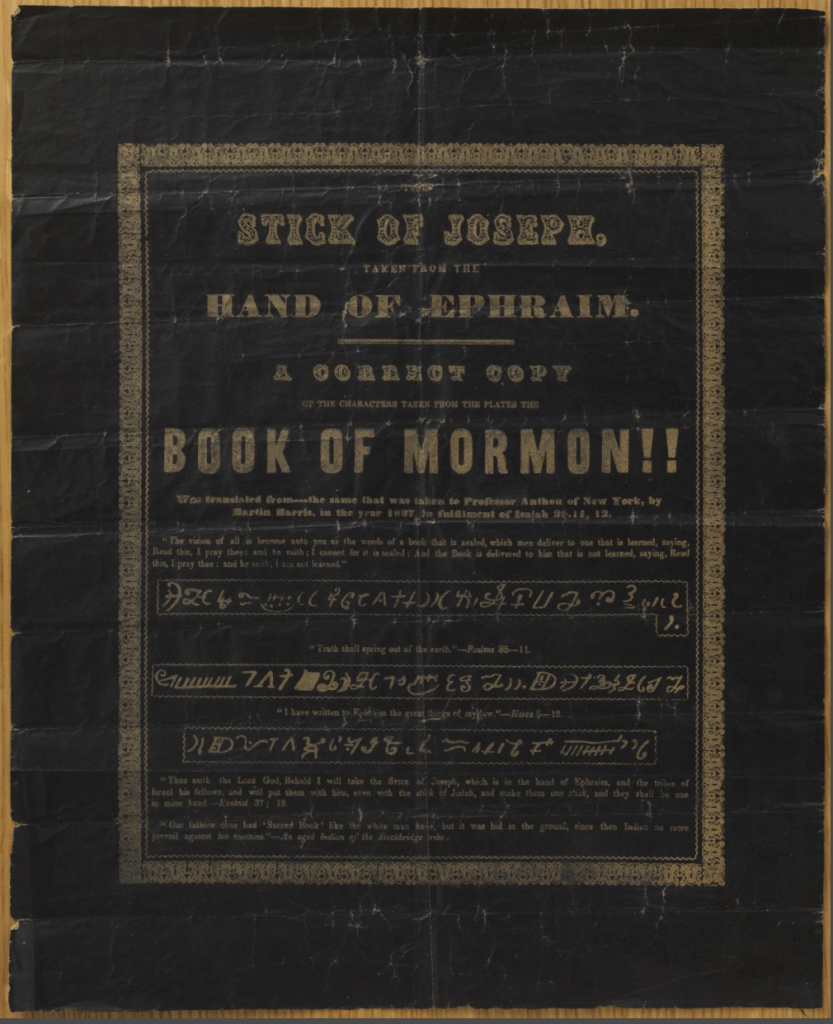
Let’s review the prophecy of the sealed book found in both Isaiah 29 and 2 Nephi 27 and see if Joseph and Martin’s stories match up well enough to confirm that this event fulfilled it.
Isaiah 29:11-12
11 And the vision of all is become unto you as the words of a book that is sealed, which men deliver to one that is learned, saying, Read this, I pray thee: and he saith, I cannot; for it is sealed:
12 And the book is delivered to him that is not learned, saying, Read this, I pray thee: and he saith, I am not learned.
The imagery in Isaiah’s prophecy describes a sealed book being delivered to the learned man who then says he cannot read it because it is sealed. Something that both the 1832 and 1838 stories have in common is that in neither version does the professor ever actually see the plates. They were never delivered to the learned man as Isaiah 29:11 prescribes. If the book was never delivered to the learned man how could Isaiah’s prophecy be fulfilled? There are more discrepancies within both accounts of the story that contradict the Isaiah prophecy.
1832 Contradictions
- The sealed book is not delivered to the professor, only copied characters of the unsealed portion.
- The unlearned man says “I cannot [translate] for I am not learned” but he had already been translating them since 1827.
1838 Contradictions
- The unlearned man says “I cannot [translate] for I am not learned” but Joseph had sent Harris to Anthon with translations of the copied characters.
- The learned man, Anthon, is able to read the characters and verify the translation.
- A second learned man, Mitchill, also reads and verifies the translated characters.
- The book was not delivered to Joseph for a second time, he had it the whole time.
Now let’s compare that to the version of this prophecy found in the Book of Mormon, 2 Nephi 27. Keep in mind, the encounter with Martin Harris and professor Anthon took place in February 1828, before the official translation of the plates began. So this passage of the Book of Mormon was written just one year after Harris’s meeting with Professor Anthon.
2 Nephi 27:15-20
15 But behold, it shall come to pass that the Lord God shall say unto him to whom he shall deliver the book: Take these words which are not sealed and deliver them to another, that he may show them unto the learned, saying: Read this, I pray thee. And the learned shall say: Bring hither the book, and I will read them.
16 And now, because of the glory of the world and to get gain will they say this, and not for the glory of God.
17 And the man shall say: I cannot bring the book, for it is sealed.
18 Then shall the learned say: I cannot read it.
19 Wherefore it shall come to pass, that the Lord God will deliver again the book and the words thereof to him that is not learned; and the man that is not learned shall say: I am not learned.
20 Then shall the Lord God say unto him: The learned shall not read them, they have rejected them, and I am able to do mine own work; wherefore thou shalt read the words which I shall give unto thee.
In Joseph’s dictation of the Book of Mormon, those two verses from Isaiah 29 were expanded into six verses with a lot of added dialogue. Isaiah 29:11 says that the book is sealed, but 2 Nephi 27:15 says that the book is only partially sealed. Let’s examine more discrepancies between the 2 Nephi 27 prophecy and both recorded accounts regarding Harris and the professor.
1832 Contradictions
- Smith says “I cannot [translate] for I am not learned” although he already been translating since 1827.
1838 Contradictions
- The unlearned man says he cannot translate because “[he] is not learned,” but Smith had already translated the copied characters.
- The learned man is able to read the copied characters and verify Smith’s translation.
- The book was never delivered to the learned man, but verse 19 says the book was delivered again to the unlearned, though Smith had possession of it the whole time.
I noticed something interesting on the 1838 manuscript history, there is a sentence written with a darker pen, added sometime after the fact. The darker insertion says: “Informed him that part of the plates were sealed and that I was forbidden to bring them, he replied ‘I cannot read a sealed book.’” This part of the narrative is not only missing from the 1832 version, but it appears to be an afterthought in the 1838 version as well. Coincidentally, this additional phrase is the only part that matches the 2 Nephi 27 prophecy verbatim.

There is a grammatical error in the 2 Nephi 27 prophecy that points to the book’s uninspired origin. Verse 20 uses the conjunction “wherefore” which means “as a result.” This verbiage makes it sound like God’s original plan was for the learned man to translate the book, but as a result of his rejecting it, God chose the unlearned man to translate it instead.
On a different note, verse 16 doesn’t match the Isaiah prophecy at all, but it seems Joseph left a little hint of his own motives. It claims that the Professor wanted to “get gain” by obtaining the gold plates. Though this is not mentioned by Isaiah, it is mentioned by Joseph himself in the 1832 account, as the reason why he could not obtain the plates the first time he visited the Hill Cumorah.
I cried unto the Lord in the agony of my soul “why can I not obtain them?” Behold the angel appeared unto me again and said unto me “you have not kept the commandments of the Lord which I gave unto you therefore you cannot now obtain them for the time is not yet fulfilled therefore thou wast left unto temptation that thou mightest be made acquainted with the power of the advisory, therefore repent and call on the Lord thou shalt be forgiven, and in his own due time thou shalt obtain them.” For now I had been tempted of the adversary and sought the plates to obtain riches and kept not the commandment that I should have an eye single to the Glory of God.
Of course, to account for the adding to scripture Joseph claimed that Bible passages like Isaiah had been incorrectly translated or inadequately preserved. That story was believable for many at the time, but it’s time we put it to rest. With the discovery of the Dead Sea Scrolls, now completely translated into English, we can compare our Bible’s Isaiah text to the Dead Sea Scrolls Isaiah text. These scrolls are a relic of Jewish boy’s rigorous practice of memorizing books of scripture. They often did this by copying word for word the ancient texts. The Hebrew translators of the Dead Sea Scrolls have confirmed that the books of Isaiah found in the Qumran caves were word for word copies of the Book of Isaiah we have today. With only minor differences in the choice of English words during translation, the Dead Sea Scrolls text of Isaiah 29 confirms the original we read in our Bibles.
Dead Sea Scrolls Isaiah 29
11 All vision has become to you like the words of a book that is sealed, which men deliver to one who is educated, saying, “Read this, please;” and he says, “I can’t, for it is sealed;”
12 And the book is delivered to one who is not educated, saying, “Read this, please;” and he says, “I can’t read.”
Conclusion
By comparing the two versions of the prophecy and the two versions of the story, I see far more contradictions than confirmations. Professor Anthon never certified or authenticated any of the characters Harris showed him. Though warned they were a hoax, Harris was still deceived enough to trust Joseph’s suspicious translation. Subsequently, Joseph used the conversation between Harris and the professor as a framework in which to embellish a fully false story to convince people of a fulfillment of prophecy.
As the interaction between Harris and Anthon occurred before the Book of Mormon was dictated/written it’s not hard to imagine that Joseph included his version of this Isaiah prophecy into the Book of Mormon to convince the reader of the book’s alleged divine origin and Joseph’s divine gift.
However the original telling of the Harris/Anthon conversation fulfilling prophecy hinged on the professor not being able to read the characters, that matched the prophecy that the learned could not read it. But after Harris was excommunicated, Smith further embellished the story claiming Professor Anthon verified his translation to increase perceived credibility of his work. Smith’s lie that the professor verified the translation contradicted both witnesses and the prophecy that the learned man “shall not read them” (2 Nephi 27:20).
Between 1828 and 1832, Joseph’s aim was to have the prophecy in 2 Nephi 27 match Isaiah 29 well enough to suggest that it was fulfilled by Martin Harris and Professor Anthon. However it’s evident that by 1838 Joseph’s goal was to convince the people of the Book of Mormon’s true translation, so forgetting the prophecy that the learned man would not read it, he claimed that the learned man not only read it but also verified it’s correct translation. He further claimed that a second professor, Samuel Mitchill, certified the translation as well. However Professor Anthon’s three accounts all maintain that Martin Harris came to him after Mitchill first inspected the characters, said he didn’t recognize them and referred him to Anthon.
In the end, Joseph’s eagerness to be believed revealed his own lies.
But What About the Prophecy?
My interest in this topic originated from my own personal study of the Old Testament. As I read about King Josiah’s temple reform in 2 Kings 22 I noticed some similarities with the foretold book. After some quick research I learned that Isaiah chapter 29 was written just about 80 years before King Josiah’s reform and that there are more matching details than just the book. I believe by carefully examining the details of Isaiah 29 we will discover many confirmations that the events surrounding Josiah’s reform fulfilled the Isaiah’s prophecy. In studying the entirety of the Isaiah 29 text, it’s evident that this prophecy has no place in the Book of Mormon.
Read my next article on why I believe King Josiah’s Reform fulfilled Isaiah’s prophecy of the sealed book.

 Ex-Mormon Bible Study

Leave a reply to Evidence Central, Part 55, Witnesses: The Anthon Account (#219) – TOYBOM: The One Year Book of Mormon Cancel reply