
One of the biggest issues Christians have with LDS theology is their view of the nature of God. The nature of God is also one of the hardest things people wrestle with after leaving Mormonism. LDS theology taught us that “the Father and the Son have tangible bodies of flesh and bones.” Further, they teach that God is an exalted man, and that he and his heavenly wife (or wives) he created all of us literal offspring, including Jesus and Satan who are two of our brothers.
In this article we will discuss these topics: the nature of God and Jesus in LDS theology, the Biblical nature of God and Jesus, the concept of the Trinity, and LDS talking points on Bible verses that refer to becoming Gods.
Nature of God in LDS Theology
In Joseph Smith’s King Follett Discourse he taught that God is simply “an exalted man” who was not always God, but a mortal man who progressed into Godhood.
“It is necessary we should understand the character and being of God and how He came to be so; for I am going to tell you how God came to be God. We have imagined and supposed that God was God from all eternity. I will refute that idea, and take away the veil, so that you may see.
These ideas are incomprehensible to some, but they are simple. It is the first principle of the gospel to know for a certainty the character of God, and to know that we may converse with Him as one man converses with another, and that He was once a man like us; yea, that God himself, the Father of us all, dwelt on an earth, the same as Jesus Christ Himself did.”
The Plan of Salvation teaches this same principle, that those who earn the highest degree of heaven can also progress into Godhood. D&C 76:95 even claims that those who obtain the celestial kingdom will become equal to God in “power and might and dominion.”
Up until the early 2000s, the LDS church taught that those who obtain the celestial kingdom will become just like God, creating their own worlds and populating them with their own spirit children. This doctrine is called exaltation, and although in recent years the church has stepped back from preaching the details of this doctrine, we can still find them hidden in old conference talks, archived Gospel Principles manuals and church magazines.
“You have got to learn how to be gods yourselves, and to be kings and priests to God, the same as all gods have done before you, namely, by going from one small degree to another, and from a small capacity to a great one; from grace to grace, from exaltation to exaltation, until you attain to the resurrection of the dead, and are able to dwell in everlasting burnings, and to sit in glory, as do those who sit enthroned in everlasting power.” (Joseph Smith, King Follett Discourse)
“All those who are counted worthy to be exalted and to become Gods, even the sons of God, will go forth and have earths and worlds like those who framed this and millions on millions of others.” (Brigham Young, Journal of Discourses volume 17, page 143)
“Each one of you has it within the realm of his possibility to develop a kingdom over which you will preside as its king and god. You will need to develop yourself and grow in ability and power and worthiness, to govern such a world with all of its people.” (Spencer W. Kimball, “…the Matter of Marriage” [address delivered at University of Utah Institute of Religion, October 22, 1976], quoted in Doctrines of the Gospel Student Manual, chapter 10)
“The real life we’re preparing for is eternal life… God, our Heavenly Father, wants us to live the life that He does. We learn both the spiritual things and the secular things “so we may one day create worlds [and] people and govern them.” (Henry B. Eyring, quoting Spencer W. Kimball, Ensign, October 2002)
“Exaltation is eternal life, the kind of life God lives. He lives in great glory. He is perfect. He possesses all knowledge and all wisdom. He is the Father of spirit children. He is a creator. We can become like our Heavenly Father. This is exaltation. If we prove faithful to the Lord, we will live in the highest degree of the celestial kingdom of heaven. We will become exalted, to live with our Heavenly Father in eternal families. Exaltation is the greatest gift that Heavenly Father can give His children.” (Gospel Principles Manual, chapter 47: Exaltation)
LDS theology says that through eternal progression we can develop all of God’s attributes and grow to be exactly like him, “equal in power and dominion” (D&C 76). It’s a massive lie, deception and distraction. This false doctrine has us focusing on ourselves, our merits, our achievements, our fruits. No wonder so many Latter Day Saints struggle with either self-righteousness of self-loathing. We either think too highly of ourselves, boasting in our obedience, worthiness and works — or we think too low of ourselves, thinking we’re a disappointment to God, every mistake is a disgrace and we’ve maxed out God’s grace.
So how do we correct these lies? How do we correct our understanding of God and our relationship with him? How do we interpret the scriptures that say we can become like God? These answers are all found in the Bible.
Biblical Nature of God
Our understanding of what it means to become like God is entirely dependent on what we believe the nature of God to be. If you believe that God has a physical body and one or more physical goddess wives creating endless spirit children & worlds together, then your idea of becoming like God is becoming an exalted physical bodied God with a wife (or wives) eternally procreating spirit babies to populate your worlds. But if you believe that God is spirit, God is love and Jesus is God in the flesh, then you start to understand that becoming like God is to embody love, goodness, peace and all the fruits of the Holy Spirit.
So if the real question is “what is the true nature of God?” I’m sticking with what Jesus said: God is spirit. Some LDS critics ask if that means I believe God is a void, shapeless, mist. No, God created us in His image. His spiritual image was the blueprint for our spiritual and physical images.
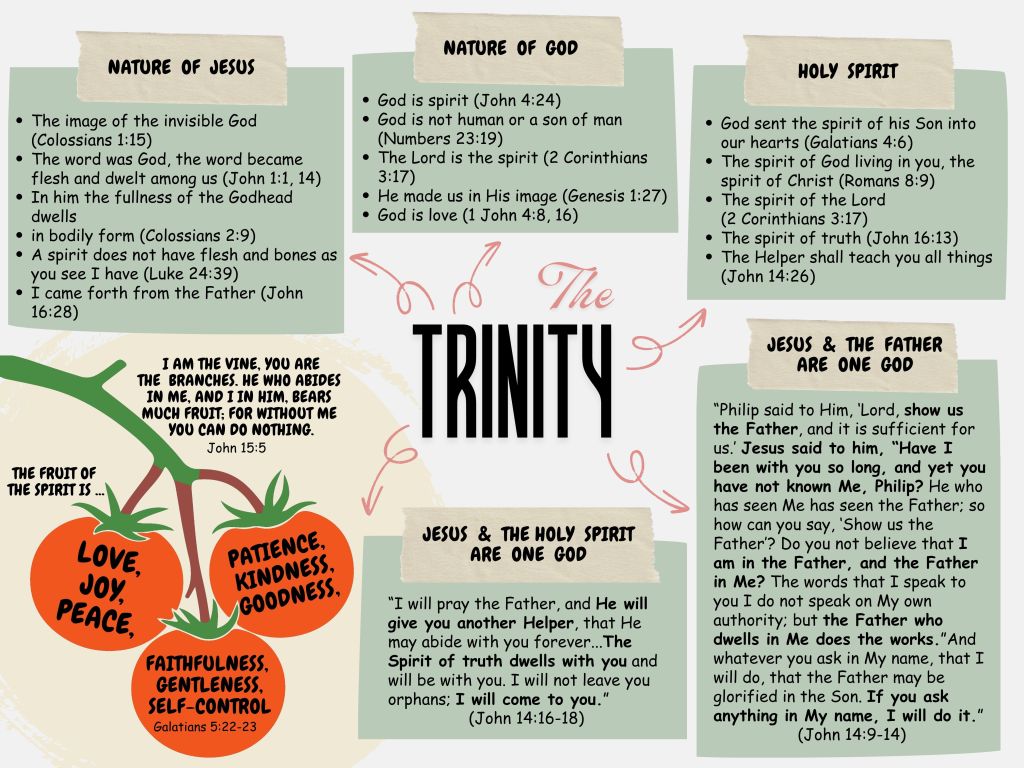
Biblical descriptions of God:
- God is spirit (John 4:24)
- God is not human or a son of man (Numbers 23:19)
- The Lord is the spirit (2 Corinthians 3:17)
- He made us in His image (Genesis 1:27)
- God is love (1 John 4:8, 16)
Jesus said it himself, God is spirit! This verse has been so overlooked by Mormon Bible readers. I remember skimming over this passage as a faithful Mormon and having the cognitive dissonance set in. As I’d memorized the 13 Articles of Faith in primary, I’d been trained to be skeptical of anything I read in the Bible. “Well, as far as it’s translated correctly, right? We know the truth, God has a body.” What audacious ignorance.
In the beauty of God’s wisdom, He preserved thousands of ancient Biblical texts. Contrary to Joseph Smith’s intimations of Biblical inaccuracy, we have the actual manuscripts available to read and confirm that yes, they are translated correctly. In fact, with the discovery of more ancient manuscripts, scholars confirm that newer translations are getting ever closer to the original meaning. If you want to explore this subject more, I recommend watching this interview with J Warner Wallace the author of Cold Case Christianity, and reading the book as well.
One of my favorite study tools is Bible Hub, where I can easily read any verse in every translation and compare it to the original Greek or Hebrew. Here’s the breakdown of John 4:24 in the original Greek.
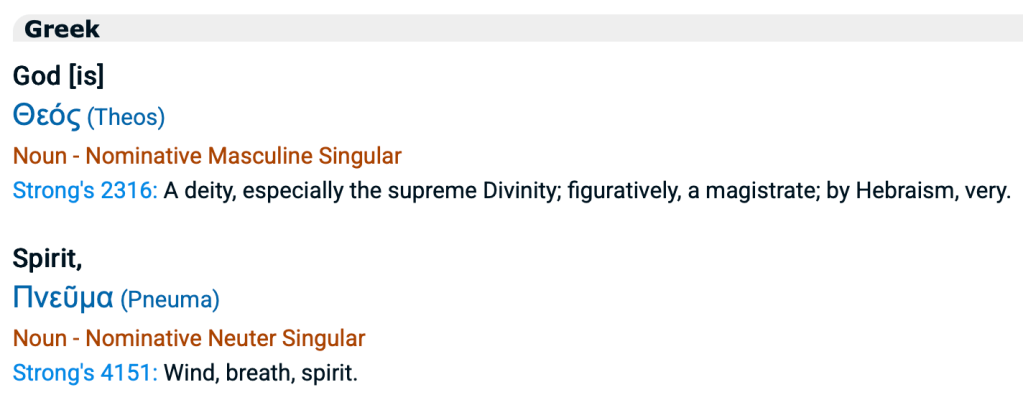
Joseph Smith’s theory that God is an exalted man is completely debunked by several clear to understand, correctly translated Biblical passages. When Jesus said “God is spirit,” He meant that, that’s the truth. Not a human with a spirit, not an exalted man, a spirit.
Biblical descriptions of Jesus:
- The image of the invisible God (Colossians 1:15)
- The word was God, the word became flesh and dwelt among us (John 1:1, 14)
- In him the fullness of the Godhead dwells in bodily form (Colossians 2:9)
- A spirit does not have flesh and bones as you see I have (Luke 24:39)
- I came forth from the Father (John 16:28)
From these verses we see that God put his own spirit into the physical body of Jesus and called it the Son. The only begotten, or only unique, son. He was the Son of Man (human) but the spirit inside him was of God the Father. That’s why Jesus called the woman with the issue of blood “daughter” and the paralyzed man “son.” Jesus is not our brother, he is the physical manifestation of the spirit of God the Father. God “became flesh and dwelt among us” (John 1:1, 14). God the spirit and Jesus, the incarnation of God’s spirit, exist simultaneously.
Is it a little confusing? Does it seem incomprehensible? That’s ok, it’s supposed to be. That’s the beauty of the mystery of God.
“And without controversy great is the mystery of godliness: God was manifested in the flesh, justified by the spirit.” (1 Timothy 3:16)
We were never meant to perfectly understand the mystery of God, that’s why it’s called a mystery. His glory and omnipotence are not simply explained. Trust me, as I’ve made it my life’s work to analytically break down every false LDS doctrine and clearly explain Biblical truth, I came up short when trying to describe God’s multi-dimensional grandeur in simple terms. I realized that’s just another folly of Mormon faith, thinking we can perfectly understand God when He himself has declared we can’t.
“Can you fathom the mysteries of God? Can you probe the limits of the Almighty? They are higher than the heavens—what can you do? They are deeper than the depths below—what can you know?” (Job 11:7-8)
“For my thoughts are not your thoughts, neither are your ways my ways,” declares the Lord. “As the heavens are higher than the earth, so are my ways higher than your ways and my thoughts than your thoughts.” (Isaiah 55:8-9)
“No one can comprehend what goes on under the sun. Despite all their efforts to search it out, no one can discover its meaning. Even if the wise claim they know, they cannot really comprehend it.” (Ecclesiastes 8:17)
There is one chapter in the New Testament that describes the reality of Jesus’s identity most clearly, that is John chapter 14. Jesus himself explains his identity as both the Father and the Spirit.
Jesus and the Father are one
In John 14:8-10, Philip asks Jesus to show them the father, Jesus answers him by saying he’s been with them the whole time. His words are bold and clear, anyone who has seen Jesus has seen the Father because the Father is in Him.
8 Philip said to Him, “Lord, show us the Father, and it is sufficient for us.”
9 Jesus said to him, “Have I been with you so long, and yet you have not known Me, Philip? He who has seen Me has seen the Father; so how can you say, ‘Show us the Father’?
10 Do you not believe that I am in the Father, and the Father in Me? The words that I speak to you I do not speak on My own authority; but the Father who dwells in Me does the works.
Now pay attention to what he says about who does the works of God. Verse 10 says “the Father who dwells in me does the works.” But then in verses 13 and 14 he says HE will do them. He’s not contradicting himself, he’s using God the Father and the name of Jesus interchangeably because they are one.
13 And whatever you ask in My name, that I will do, that the Father may be glorified in the Son.
14 If you ask anything in My name, I will do it.
Jesus says that it’s the Father that does the works of God, and if we ask in His name He will do them because they are one!
Why is he talking this way? Couldn’t he be more clear than to use Father/Son, Yahweh/Jesus interchangeably? At first it was a little confusing, I admit my eye was twitching for quite some time trying to understand it. Then God showed me something.
I thought back to when Yahweh first revealed himself to Abraham. He established his people by revealing Himself as the one true God, creator of the universe, calling them out of pagan worship of other gods. Over the next 2,000 years, the Abrahamic religion had developed into several variations: Samaritans had their own version of the Torah and dabbled in paganism, Pharisees focused entirely too much on the letter of the law and oral traditions, the wealthy Sadducee priests controlled the temple but didn’t believe in an afterlife, Zealot’s faith led them to physical violence, the Essenes isolated in the desert awaiting the end times, and common Jews were trampled by religious authorities’ greed and spiritual superiority.
By the time Jesus came to earth the Abrahamic religion was already a polluted mess. What did it mean if you claimed to worship Yahweh? All worshiped the same God, but at the same time, it was culturally taboo to say the name of God. Jesus changed everything. He challenged every twisted idea of God and declared His own name the missing link between God and man. Jesus is the name above all names, and not only is it not taboo to say it, but He instructed us to use His name to access God’s power and authority.
“In My name they will cast out demons” (Mark 16:17)
“… Stretching out Your hand to heal, and that signs and wonders may be done through the name of Your holy Servant Jesus.” (Acts 4:30)
Jesus & the holy spirit are one
A few verses later in John 14, Jesus says he is leaving this physical world but he will not leave his friends comfortless. He says the Father will give them another helper, the spirit of truth, or Holy Spirit.
16 And I will pray the Father, and He will give you another Helper, that He may abide with you forever—
17 The Spirit of truth, whom the world cannot receive, because it neither sees Him nor knows Him; but you know Him, for He dwells with you and will be in you.
18 I will not leave you orphans; I will come to you.
Verse 18 is key. In explaining that the Holy Spirit will dwell with them, Jesus says he will not leave them orphans (being without their Father) but HE will come to them. Again, not only are Jesus and the Father one, but Jesus and the Holy Spirit are one. It is the spirit of Christ that surrounds and fills us, not a separate soul sent to deliver warm fuzzies.
Looking closer at these verses I noticed that they lie within a chiasm. If we love Him and keep His commandments, He will come to us, His spirit will dwell with us, and He will manifest Himself to us.
15 If you love Me, keep My commandments.
16 And I will pray the Father, and He will give you another Helper, that He may abide with you forever—
17 the Spirit of truth, whom the world cannot receive, because it neither sees Him nor knows Him; but
you know Him, for He dwells with you and will be in you.
18 I will not leave you orphans; I will come to you.
19 A little while longer and the world will see Me no more, but you will see Me. Because I live, you
will live also.
20 At that day you will know that I am in My Father, and you in Me, and I in you.
21 He who has My commandments and keeps them, it is he who loves Me. And he who loves Me will be loved
by My Father, and I will love him and manifest Myself to him.
What commandments is Jesus taking about? Jesus didn’t preach about sacrifices, tithing, or covenants. Jesus did say the most important commandment was to love God and love others (Matthew 22:36-40). He commanded us to forgive one another (Luke 6:37) and be generous (Matthew 5:42). He commanded us to not swear oaths (Matthew 5:34) or store up earthly treasures (Matthew 6:19). But most importantly Jesus commanded us to abide in Him (John 15:4). The command to abide in Him comes directly after this chiasm about the helper, the comforter, the spirit of truth. His promise is that when we abide in Him, he will abide in us by means of the Holy Spirit.
Biblical descriptions of the Holy Spirit:
- God sent the spirit of his Son into our hearts (Galatians 4:6)
- The spirit of God living in you, the spirit of Christ (Romans 8:9)
- The spirit of the Lord (2 Corinthians 3:17)
- The spirit of truth (John 16:13)
- The Comforter shall teach you all things (John 14:26)
- The fruit of the spirit are love, joy, peace, patience, kindness… (Galatians 5:22-23)
The New Testament repeats several times that the Holy Spirit IS the spirit of God, the spirit of Jesus living in us. The spirit of the Lord is the spirit of truth that teaches us all things. And the Holy Spirit makes the fruit of the spirit accessible to us. Just as fruit comes from a vine, Jesus is the true vine and all of the fruits of the spirit come from Him.
“I am the vine, you are the branches. He who abides in Me, and I in him, bears much fruit; for without Me you can do nothing.” (John 15:5)
“But the fruit of the Spirit is love, joy, peace, patience, kindness, goodness, faithfulness, gentleness, self-control.” (Galatians 5:22-23)
The most life changing thing I’ve learned since God pulled me out of Mormonism is this: I cannot produce the fruits of the spirit by my own merit. As John 15:5 says, we can do nothing without Him. He is the one who produces the fruit. We may try to be more patient, peaceful, kind, gentle, or faithful, but none of those can last coming from our own strength. But when we learn to abide in Him, the fruits of his vine become abundant in our lives– his love, peace and joy fill our souls and it’s not from our striving, its from our abiding in Him. It’s the peace that surpasses all understanding, I’ve tasted it in some of my lowest moments. Once you taste it you want it forever. I believe that’s what God is, and that’s what heaven will feel like.
Is This the Trinity?
Before writing this article I wasn’t sure I agreed with the Christian term “Trinity” to describe the nature of God. However after pondering over all these verses and discovering what Jesus himself said in John 14 it clicked. If the definition of the Trinity is “One God, Father, Son, and Holy Spirit, three persons equal in divine essence and glory” then I think I agree. Conceding that God himself said we can’t truly comprehend the mystery of godliness (1 Timothy 3:16) gives me peace that I’m not missing any critical information. It suffices to know that God is Love, Jesus Christ is God in the flesh, and His Holy Spirit fills me with inexplicable peace.
If you’re still having a hard time understanding the Triune God, the next best way I can fathom to explain it is based on the knowledge that God is outside of time constraints and is multi-dimensional. It’s as if the Father, the Son and the Holy Spirit, all one God, simultaneously exist in dimensions and timelines that our human minds can’t comprehend.
LDS Talking Points
Now that we’ve covered the Biblical nature of God, let’s revisit the LDS view of the nature of God. Here we’ll thoroughly investigate several Biblical verses Mormons quote to support their theology. These bible verses have been quoted in conference talks and cited on the church website as evidence of their theology that God is a physical bodied exalted man and that man can progress to be exalted and become a God.
Psalm 82:6
“You are gods, and all of you are children of the Most High.”
Psalm 82:6 is often referenced in LDS theology as evidence that God calls us humans gods, and that we are progressing on our way to Godhood. But this interpretation is easily refuted when we read the context of the chapter.
The first verse of this chapter opens with God standing in the midst of the divine council/great assembly/heavenly courts (depending on the translation), “judging the gods.” The original Hebrew says Elohim, that means God plural. Yes in Psalm 82, God is actually talking to other spiritual beings, called gods in the Old Testament, or the New Testament calls them principalities and powers in heaven (Ephesians 3:10). He addresses these spiritual powers and he is clearly unhappy with them, so much so that in verse 7 he says they will “die like men.” This could open up a whole other discussion on the fallen angels mentioned in Genesis 6:4, Isaiah 14:12, and Jude 1:6. I’m not going to go down that tangent in this article, for more on that topic I recommend the book The Unseen Realm. But suffice it to say that Psalm 82 is not calling humans gods, it’s calling spiritual powers gods.
There is a different interpretation of this Psalm however, one that does not account for other spiritual beings mentioned in the Bible. This other interpretation, common in Jewish history, proposes that the “gods” mentioned in the heavenly courts were earthly judges and leaders. They saw themselves as the most holy men, acting as God, judging and leading his people. I believe it’s this interpretation that Jesus was referring to when he quoted Psalm 82 in John 10:34.
Is it not written in your Law, “I said, you are gods”? If he called them gods to whom the word of God came — and Scripture cannot be broken — do you say of him whom the Father consecrated and sent into the world, “You are blaspheming,” because I said, “I am the Son of God”? (John 10:34–36)
In this passage, the Pharisees were preparing to stone him for blasphemy for calling himself the Son of God. Jesus responded by quoting their own misinterpretation of scripture, as they claimed the phrase “you are gods” referred to themselves. Here we see Jesus do the same thing he’s done every time the Pharisees accuse him of blasphemy, he turns it back on them to expose their hypocrisy. Here’s a great article explaining this more.
Romans 8:16-17
“The Spirit Himself testifies with our spirit that we are God’s children. And if children, then heirs; heirs of God and joint heirs with Christ,if indeed we suffer with Him, that we may also be glorified together.”
In LDS circles, Romans 8:16-17 is often quoted to support the idea that humans can become Gods. The word heir is emphasized, suggesting that just as a prince is an heir to rule over the kingdom, we are also heirs who will rule over kingdoms like God and Jesus. However one important thing must happen for a prince in the line of succession to become king—the king must die. Of course God is not going to die, and we are not going to inherit his position of power and authority by any means. The message here is so much more simple, as children of God we can inherit the glorious heavenly home where God our father lives, joint heirs with Jesus. Living in His presence does not mean taking on His inherent omnipotence or authority.
Joseph Smith taught that those who make it to the celestial kingdom to dwell in God’s presence will be made equal to God “in power, and in might, and in dominion” (D&C 76:95). The LDS Gospel Principles Manual states “[God] has all knowledge, all power, and all wisdom. We can someday become like Him. This is exaltation.” However Jesus says in Luke 20:35-36, “those who are counted worthy will be equal to the angels,” not equal to God.
“Jesus said to them, ‘The sons of this age marry and the women are given in marriage, but those who are counted worthy to attain that age, and the resurrection from the dead, neither marry nor are given in marriage; nor can they die anymore, for they are equal to the angels and are sons of God, being sons of the resurrection.’” (Luke 20:35-36)
And of course I have to mention how this verse contradicts the LDS belief that people who don’t marry or get sealed in this life will have the opportunity to do so in the next life, thus progressing as husband and wife to Godhood. (More on the biblical view of marriage and families in the after life in this video.)
“The covenant of eternal marriage is also needed for exaltation… The Lord knows that not all of His children will have the opportunity to be married in this life. He has promised that all who accept the gospel and strive to keep their covenants will have the opportunity to be married and have children either in this life or the next.” (About Temple Sealings)
1 John 3:2
“Beloved, now we are children of God; and it has not yet been revealed what we shall be, but we know that when He is revealed, we shall be like Him, for we shall see Him as He is.“
LDS theology suggests that 1 John 3:2 teaches that we shall be like God by becoming Gods ourselves. But considering all the other verses about no other gods, we see what a stretch that is. There are so many other ways we can be LIKE God in the eternities. He is immortal, we will be resurrected immortal (1 Corinthians 15:53, 2 Timothy 1:10). He is full of love, we can be full of love (Romans 5:5, Ephesians 3:19). He is merciful, gracious, patient kind — insert any other fruit of the Spirit — and we can be too as we are filled with His spirit (Colossians 3:12-13).
Genesis 3:22
“Then the LORD God said, ‘Behold, the man has become like one of us, knowing good and evil. Now, lest he reach out his hand and take also of the tree of life and eat, and live forever.‘”
Genesis 3:22 is often quoted to support the claim that God himself said that Adam and Eve had become like God and could continue to progress into Gods themselves. However, just like I mentioned with the last verse, this passage specifically describes in what way Adam and Eve had become LIKE God, in knowing good and evil. Before eating the fruit, they were innocent and did not know right from wrong. After their transgression their eyes were opened and they knew what they had done was wrong.
It’s kind of silly to think that after humanity’s first sin against God, God stated that they were now Gods or could become Gods. They had just barely made their first mistake and received their consequence. Their understanding of good and evil was new and incomplete. God on the other hand is omniscience, knowing everything, and always has been. He is the FIRST and the LAST (Revelation 22:13), there is no other God before or after him (Isaiah 46:9-10).


Leave a Reply